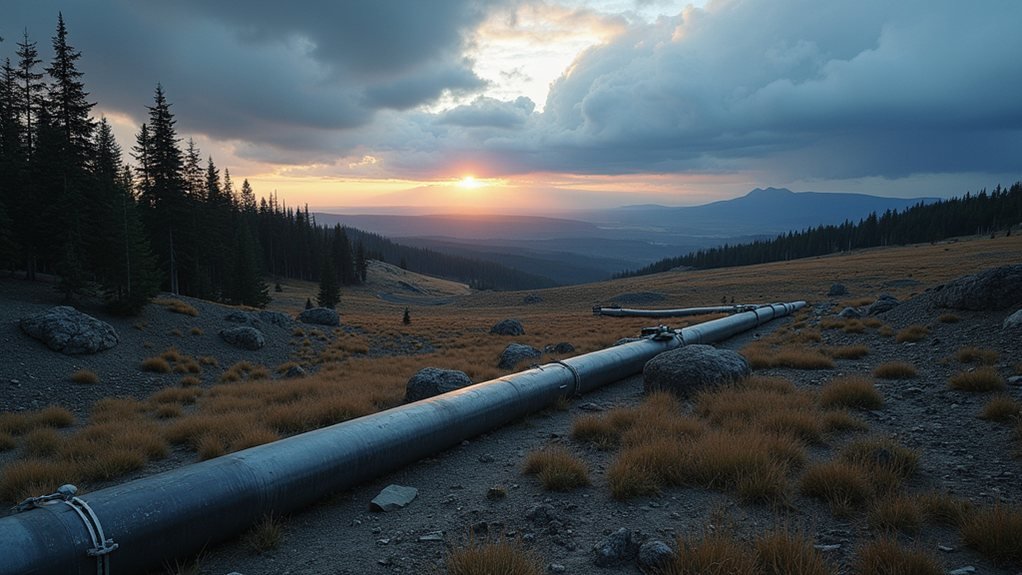

The pipeline saga across Canada and the U.S. is a high-stakes drama, featuring Indigenous land defenders challenging state power and mega-corporations. Imagine a tug-of-war where human rights and environmental justice are at one end, and profit-driven ventures at the other. State violence often elbows its way in, casting a shadow over Indigenous rights. The fascinating saga continues as legal frameworks and resistance movements evolve. Stay tuned to witness how this gripping narrative unfolds.
Quick Overview
- Indigenous land defenders actively oppose pipeline projects through protests, emphasizing cultural preservation against economic interests.
- The RCMP CRU uses counterterrorism tactics to manage and suppress Indigenous resistance in pipeline disputes.
- Legal frameworks like UNDRIP underscore the need for Indigenous consent in pipeline projects, challenging current consent practices.
- Surveillance and monitoring of Indigenous activists by contractors complicate the dynamics of pipeline protests and state interventions.
- Economic empowerment offered by pipeline investments often conflicts with deep-rooted Indigenous cultural and environmental values.
Canada-US Pipeline Projects and Indigenous Lands
When it comes to the ongoing discussion about Canada-US pipeline projects and Indigenous lands, one might think of it as a modern game of territorial Tetris, where every move and match carries weighty consequences.
Indigenous communities have cleverly acquired stakes in over 5,000 km of pipelines, gaining the title of third-largest collective owners of clean energy assets. While some see this as Indigenous empowerment, others argue it’s not all rainbows and butterflies. Notably, government-backed loan guarantees have played a pivotal role in facilitating these investments, enabling Indigenous groups to overcome financial barriers and engage more actively in the energy sector. Alberta’s proposals for pipelines emphasize Indigenous leadership and promise economic gains, yet these projects often cross traditional territories, sparking complex cultural and environmental concerns. To address these concerns, the integration of environmental and safety management systems ensures compliance with safety and environmental standards. The Alberta government is committed to maintaining high safety standards with a 99.999% safety record for pipelines across the province.
Indigenous communities rank third in clean energy assets but face challenges beyond empowerment.
It’s pipeline diplomacy, folks!
How Indigenous Land Defenders Protect Their Land
Imagine this: a complex game of chess where the pieces include not just knights and bishops, but bulldozers and legal documents. Indigenous land defenders are masters of this board. They occupy sites, like Wet’suwet’en defending against Coastal GasLink, putting their bodies on the sacred line. Their defensive repertoire includes legal jousts—like battling 19 contempt charges—demanding compliance with the linguistic gymnastics of the UNDRIP. Despite the agreements signed by elected First Nations governments, which often conflict with the Chiefs’ opposition, the Hereditary Chiefs maintain that they have never consented to the pipeline, emphasizing their commitment to defending their territories.
In these efforts, the building of sustainable and inclusive local communities plays a crucial role by forming alliances and fostering understanding across different groups.
The Northern Gateway Pipeline was canceled after a consortium of more than 60 First Nations categorized it as a “grave threat,” demonstrating the powerful impact of unified Indigenous resistance. These seasoned players bond with allies like 60 First Nations or Dene against tar sand expansions. As nature’s stalwart gatekeepers, they demand FPIC before pipelines leap rivers, insisting undeveloped lands remain vibrant, ancestral chessboards. Checkmate, anyone?
State Tactics: Impacts on Indigenous Protests
While some might think of protest as merely marching with placards, the high-stakes world of Indigenous land defense spins a much more intricate web. Enter the RCMP CRU, a unit designed post-DAPL to quash Indigenous resistance with the flair of a spy novel. Forget plain ol’ policing; this is counterterrorism chic, complete with double agents! But there’s more: tiger-striped surveillance contractors who sound like they moonlight in action flicks. Such tactics are indeed thrilling, but they’re not popcorn fare—real lives are affected. Indigenous communities are disproportionately exposed to environmental burdens, highlighting the ongoing need for environmental justice across all communities. The financial crisis facing organizations like Greenpeace USA, with reported cash and cash equivalents of $1.4 million and total assets of $23 million, highlights the precarious nature of funding for environmental activism. In this ongoing battle, Indigenous groups have vowed renewed resistance against projects like the Keystone XL, emphasizing the continued struggle for Indigenous rights and environmental justice. Despite Greenpeace’s grand courtroom drama, the heart of the matter remains: Indigenous rights and environmental justice, tangoing precariously with state power.