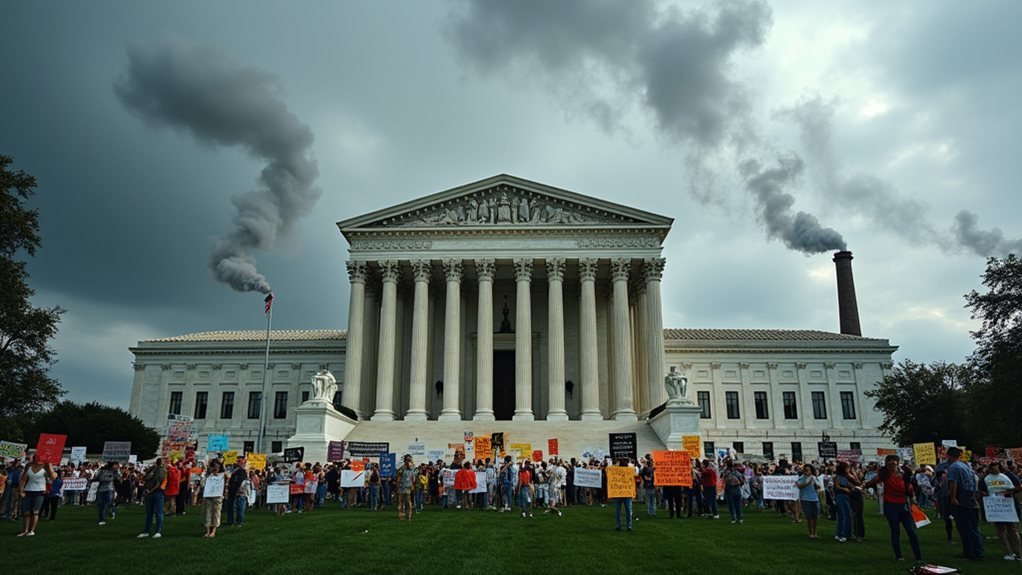
In the grand legal theater of 2026, Boulder, Colorado, stands center stage against ExxonMobil and Suncor. The lawsuit, with a plot thicker than your grandma’s chicken soup, seeks to prove these oil giants as major climate culprits. Justice Alito’s own stock drama adds a subplot of recusal debates. This courtroom thriller could set a new precedent in balancing state claims with federal law, reshaping the battlefield of climate accountability. Turn the page to see what unfolds next.
Quick Overview
- The lawsuit filed by Boulder targets ExxonMobil and Suncor as major contributors to climate change damage in Colorado.
- If the case reaches the Supreme Court, it could set a nationwide precedent for climate liability lawsuits.
- Justice Alito’s financial ties to oil companies have raised concerns over potential conflicts of interest in Supreme Court rulings.
- The main legal debate centers on whether state claims against emissions are preempted by federal law, particularly the Clean Air Act.
- A ruling in favor of Boulder could empower other local governments to pursue similar lawsuits against fossil fuel companies.
Understanding the Boulder Lawsuit Against Oil Companies
In the legal world, some battles are as epic as a superhero showdown, and the Boulder lawsuit against oil giants ExxonMobil and Suncor is no exception. Picture a showdown where local governments don their capes to confront industry titans. Filed in 2018, Boulder and its allies claimed these companies are climate villains, knowingly contributing to environmental chaos. With wildfires as common as Wi-Fi in coffee shops, costs skyrocket. Plaintiffs demand damages to relieve taxpayers. On an individual level, reducing our dependence on fossil fuels by making transportation choices like using public transportation or carpooling can significantly lower our carbon footprint. The companies, however, call for a federal shield, arguing local suits can’t reshape global policies. Boulder County’s claims have been allowed to proceed in state court following a ruling by the Colorado Supreme Court. The Supreme Court’s decision on this case could set a new precedent for climate liability cases nationwide. It’s a case of David versus Goliath, with Earth’s future at stake.
Justice Alito’s Financial Interests and Recusal Decisions
Just when you think this legal saga couldn’t get any more intriguing, enter Justice Alito’s financial interests and recusal decisions.
Picture a judge with stock in ConocoPhillips and Phillips 66—oh, but not just pocket change; up to $245,000 worth.
A judge’s oil stocks dance—up to $245,000 in ConocoPhillips and Phillips 66.
Now imagine him playing hopscotch through recusal decisions like he’s practicing a new dance move. He steps back on some cases, yet slips confidently into others, even when oil giants are tangentially involved. Concerns arise over whether Justice Alito’s financial interests could affect his impartiality in the Supreme Court’s ruling on the climate impact lawsuit involving fossil fuel companies like ExxonMobil and Suncor Energy. Evaluating environmental and social performance is crucial in determining the sustainability impact of such legal decisions on both local and global scales.
The judicial rulebook’s suggestion: recuse when impartiality is questionable.
While some justices have ties to oil interests, concerns about impartiality in cases like these linger. But here, it’s largely left to personal discretion—a true dance between legal ethics and financial interests. Curious, indeed.
Nationwide Impact of the Lawsuit
Imagine for a moment you’re in a courtroom showdown that could reverberate across an entire nation.
It’s like the Super Bowl of legal battles, and everyone’s eyes are on the field. Adding another layer of complexity, the alignment of business operations with the UN Sustainable Development Goals offers a pathway for companies to measure their contributions toward mitigating climate change impacts. This case could redefine how states tackle climate change costs, deciding if Boulder—and those rootin’ for them—can hold Big Oil accountable. The outcome of the Supreme Court’s ruling in Suncor Energy, Inc. v. Commissioners of Boulder County could set a precedent for pending climate lawsuits across the country. The argument here is whether federal law trumps state claims over greenhouse gas emissions. As Exxon and Suncor argue, climate torts like these are potentially barred by the U.S. Constitution and Clean Air Act. The Clean Air Act is like the big boss in a video game, challenging states’ puny state-law claims of public nuisance.
Meanwhile, the Supreme Court’s decision may weatherproof state efforts nationwide against climate deception.