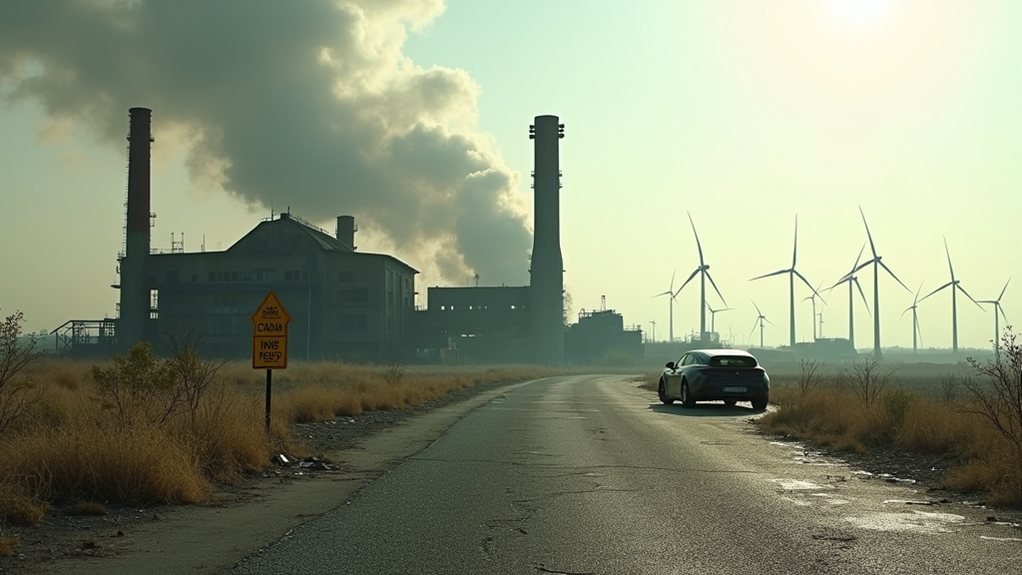

With Trump’s deregulation, it’s a bit like pulling the rug out from under climate rules and causing industries to wobble. By 2026, the uncertainty might ping-pong back, leaving companies and states scrambling to fill the regulatory void. Imagine the car industry feeling like a jittery tightrope walker, balancing investment needs amidst legal cha-cha-cha. The U.S. could see global competitiveness slide while others waltz ahead with green energy. Curious how this industry jig may unfold further?
Quick Overview
- Deregulation creates uncertainty in the auto industry, affecting investment stability and compliance with varying state regulations.
- States plan lawsuits to counter federal rollbacks, potentially leading to a fragmented regulatory environment.
- Deregulation may harm U.S. competitiveness in the global shift toward electrification and renewables.
- The $1.3 trillion savings from deregulation may be offset by increased environmental and economic costs from pollution.
- Renewable energy transitions become more challenging for power plants due to eased federal regulations.
Immediate Effects on Greenhouse Gas Regulations
When it comes to greenhouse gas regulations, the recent unraveling of the 2009 Endangerment Finding by the EPA is like pulling the thread that’s been holding together the sweater of U.S. climate policy.
This decision not only sheds the legal foundation for regulating greenhouse gases under the Clean Air Act, but it also strips away the scientific validation of federal emissions standards since 2009. Global standards for measuring and reporting greenhouse gas emissions, such as those set by international agreements, remain crucial for maintaining consistency and transparency.
Described as the largest deregulatory move in American history, this repeal purports to save $1.3 trillion.
This unprecedented rollback claims a $1.3 trillion savings, but at what environmental cost?
Furthermore, the 2019 rule rollback highlights the tension between deregulation efforts and the legal obligations of states to mitigate environmental harm, raising questions about jurisdictional authority and state-federal dynamics.
However, it’s like unplucking a Jenga tower just to claim victory; the structure’s stability remains deeply questionable.
Now, states may attempt to fill the regulatory void with their own GHG regulatory programs that go beyond cap-and-trade systems.
Industry Adjustments to Regulation Repeal
Imagine the industry like a big orchestra, hit by an unexpected change in the sheet music mid-concert – that’s what the repeal of greenhouse gas regulations feels like for American businesses. The auto sector finds itself amid legal tangos, with firms like Ford yearning for investment stability. Companies are now forced to navigate the regulatory chaos as several states, including California and Massachusetts, plan lawsuits against the repeal to address potential environmental impacts. Meanwhile, API supports methane regulations, aiming to court favor with the EU, America’s LNG aficionado. The hydrocarbon haze darkens as air pollution, contributing to the premature deaths of thousands annually, becomes an increasingly recognized economic burden in the U.S. Businesses face pressure to implement supply chain evaluation practices to maintain sustainability and public approval. Power plants bask in regulatory ease, complicating the tune of renewable shifts. But, like a cat in a yarn factory, businesses face tangled legal battles and regulatory chaos, making it tricky to harmonize future investments with present uncertainties.
Global Fallout From U.S. Deregulation
Even as America loosens the regulatory reins, the ripple effect of this deregulation seems destined to make some waves on the global stage. Envision this: the U.S. transport sector, puffing out emissions like a steam train, matches Russia’s entire economy. That’s a lot of hot air! Some industry analysts argue that the repeal of the “Endangerment Finding” could lead to a significant shift in global energy dynamics by encouraging more fossil fuel production and consumption. These changes stand in stark contrast to efforts aimed at building sustainable and inclusive communities that prioritize environmental protection and social equity. Meanwhile, scrapped emissions standards mean U.S. carmakers risk falling behind, stuck in the petrol past as Europe and Asia zoom toward electrification. The reversal of the Endangerment Finding has removed the legal requirement for the U.S. to regulate greenhouse gases under federal law, further undermining emissions standards. Trade tensions tingle as the EU eyes U.S. LNG supplies with suspicion. And just like the friend who skips the reunion, America’s absence from climate talks leaves others picking up the slack.