
In the ongoing saga of pipeline protests across Canada and the U.S., land defenders are stepping up as courageous champions against corporate interests and state violence. Picture them as eco-warriors, standing firm against bulldozers while law enforcement, sporting fancy acronyms, pulls out all stops to disrupt their peaceful protests. The stakes are high, with billions at play and tensions rising, as communities rally to protect their land and rights. There’s a lot more brewing in this intricate tale of activism!
Quick Overview
- Land defenders in Canada and the US increasingly challenge pipeline projects, asserting traditional rights and environmental stewardship.
- State violence against activists, including specialized police tactics, complicates peaceful protest efforts related to pipeline expansion.
- Financial backing from crowdfunding is vital for sustaining anti-pipeline movements, illustrating strong community support against corporate interests.
- Regulatory approvals for pipeline projects are accelerating, with significant investments projected, raising concerns about environmental impacts and indigenous rights.
- The balance between energy demands and ecological sustainability remains a critical issue, amplifying the role of land defenders in ongoing activism.
The Role of Land Defenders in Pipeline Protests
In the ever-evolving saga of pipeline protests, land defenders frequently emerge at the forefront, embodying the spirit of resilience against corporate encroachment. Their commitment often reflects underlying ethical frameworks that prioritize environmental stewardship and respect for natural habitats.
These courageous individuals occupied drill sites to halt Coastal GasLink’s construction, standing firm in their traditional rights, even amid intimidating police raids. Facing charges for their steadfastness, they became symbols of resistance. Furthermore, their actions highlight the urgent need to respect the Wet’suwet’en traditional land rights as reaffirmed by the 1997 Supreme Court ruling. Despite asserting their rights, many land defenders have faced disproportionate police raids that further threaten their safety and cultural heritage.
Their peaceful actions—blocking projectors and marching in solidarity—echo a broader fight against industrialization on unceded territory. Land defenders remind us that in their world, the stakes are higher than just land; it’s about cultural survival against an army of bulldozers and business interests.
The Challenges of Activism: Exploring State Violence
While many envision activism as peaceful protests and passionate speeches, the stark reality often involves state violence lurking in the shadows.
The formation of specialized police units, like the RCMP’s CRU, mirrors tactics seen during the DAPL protests, showcasing collaboration with private security to suppress dissent. Events like the Standing Rock eviction, where water cannons met protestors in frigid weather, exemplify the extremes activists face. As protests escalate from advocacy to civil disobedience, state responses often resort to counterterrorism methods, dimming the hopeful light of activism with the threat of violence. Understanding how these actions affect environmental justice highlights the disproportionate burdens faced by marginalized communities. This trend is evident in the aggressive policing seen during the Coastal GasLink attack, reflecting an ongoing pattern of state violence against land defenders. In addition to this, over $1.9 million was raised through crowdfunding for anti-pipeline efforts, illustrating the significant financial backing that often supports dissenting movements.
The emergence of specialized police units highlights a troubling alliance with private security in stifling dissent.
Activism’s journey is perilous, yet essential for change.
What’s Next for Pipeline Projects in Canada and the US?
What exciting developments await in the world of pipeline projects across Canada and the US?
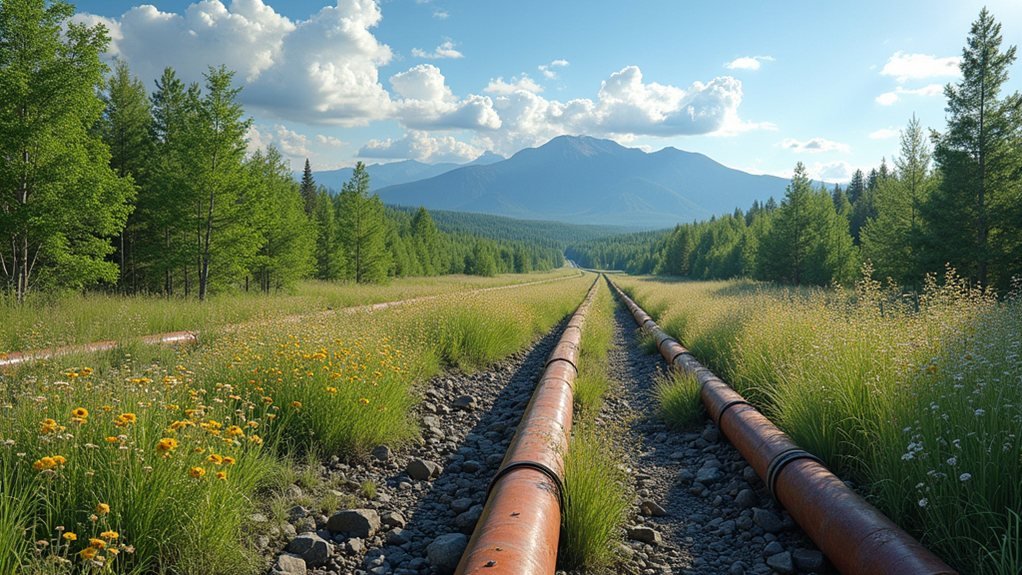
With expansions like Enbridge’s Mainline Optimization phases and Pembina’s Birch-to-Taylor project, the energy landscape is buzzing. The Bridger Pipeline expansion promises increased Canadian crude capacity, while the Trans Mountain expansion aims for major egress improvements. Integrating natural systems into project planning can help mitigate environmental impacts and promote sustainability. Regulatory approvals are speeding up, making the process feel less like waiting for a slow pot to boil. As the industry navigates the intricate dance of public interest and energy demand, projections suggest rising capacities and a $45 billion investment in projects by 2029. With the start of the Trans Mountain Expansion expected to alleviate export constraints for Western Canadian oil producers, excitement builds for future capacities and improved infrastructure. Exciting times lie ahead!