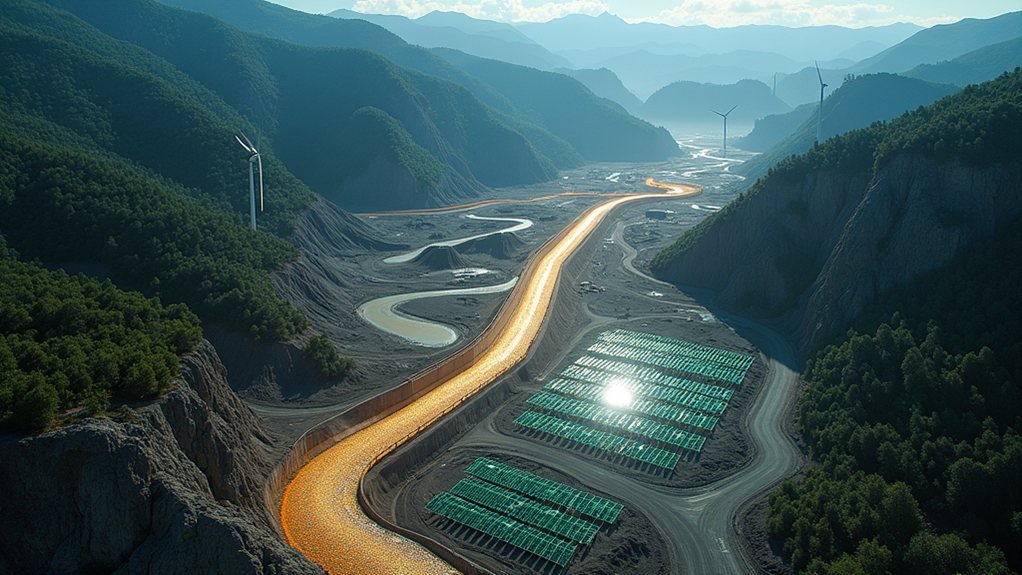

The Trump Pentagon’s OPEN AI Metals Program aims to transform the critical minerals trade by establishing clear pricing strategies. This initiative seeks to set fair reference prices for metals like germanium and gallium, mitigating foreign market manipulation, especially from China. With a focus on sustainability and investor confidence, it hopes to make the trading environment more equitable. Imagine it as a referee leveling the playing field, ensuring fair play in global metal exchanges. Stick around to explore its broader implications!
Quick Overview
- The Trump Pentagon AI Program aims to establish reliable pricing mechanisms for critical minerals to ensure fair trade practices and reduce foreign manipulation.
- A strategic focus on germanium and gallium addresses vulnerabilities posed by China’s dominance in the critical minerals market.
- The program seeks to enhance transparency in metal trading by implementing AI-driven benchmarks and tariffs to dissuade unfair pricing.
- Collaboration among stakeholders is essential to overcome funding challenges and develop alternatives to Chinese refining capacity for critical minerals.
- By 2026, the proposed strategies aim to foster a secure supply chain for U.S. and allied industries, emphasizing sustainability and accountability.
Key Goals of the OPEN AI Metals Program for Stakeholders
As the OPEN AI Metals Program gears up to redefine the landscape of critical minerals, stakeholders find themselves at the forefront of a transformative venture. This initiative aims to establish solid reference prices for essential metals like germanium and gallium, which are vital for national defense and advanced tech. By tackling the opaque pricing in niche markets, the program promises to create an environment where fair trade flourishes, free from foreign manipulation. Additionally, the program seeks to counteract alleged Chinese market manipulation, ensuring a more equitable pricing structure for U.S. producers. The initial application of the OPEN model on metals traded in low volumes demonstrates a commitment to enhancing the accuracy of pricing benchmarks. Alongside these goals, the program also emphasizes sustainable resource management to align with global efforts to reduce environmental impact.
Imagine a world where Western mines thrive, bolstered by AI-determined tariffs that level the playing field and create a secure supply chain. It’s a bold step toward mining prosperity.
Impact of OPEN AI Reference Pricing on Global Metal Trade
The impact of the OPEN AI Reference Pricing mechanism on global metal trade could be likened to a well-placed referee in a high-stakes football game—ensuring the rules are clear and fair for all players involved. This approach aligns with the increasing emphasis on ESG frameworks to enhance corporate transparency and accountability.
By stripping out market distortions and focusing on costs like labor and logistics, this innovative pricing model promotes transparency. It targets critical minerals like gallium and germanium, which have been historically vulnerable to China’s market influence. With tariffs on imports below set prices, reclassification of critical minerals as national security assets encourages investors to gain confidence, leading to a healthier market. Ultimately, the OPEN AI mechanism fosters a more predictable and equitable trading environment.
Challenges and Reactions From Stakeholders in Critical Minerals
While maneuvering through the complex landscape of critical minerals, stakeholders encounter a veritable minefield of challenges that could rival even the most intricate puzzle.
With China wielding near-total control over gallium refining, the U.S. and EU scramble to develop alternatives. New facilities lag behind, and the irony thickens as Western firms sell dreams to Chinese investors. The U.S.-China trade agreement aims to alleviate some of these pressures by temporarily suspending export controls on critical minerals, yet the uncertainty surrounding its expiration looms large. Fluctuating commodity prices significantly impact investment decisions and profitability, further complicating the already intricate situation.
Government initiatives aim for balance, yet funding struggles leave many projects in limbo. Incorporating supply chain evaluation methodologies could help align environmental and social performance goals with strategic funding decisions. It’s a classic case of needing buyers and sellers to hold hands before the dance starts.
Government efforts seek equilibrium, yet financial hurdles leave ventures in suspended animation, awaiting collaboration before progress can waltz forward.
Cooperation is key, but without coordination, it’s all just hot air—like trying to fill a balloon with a pin.