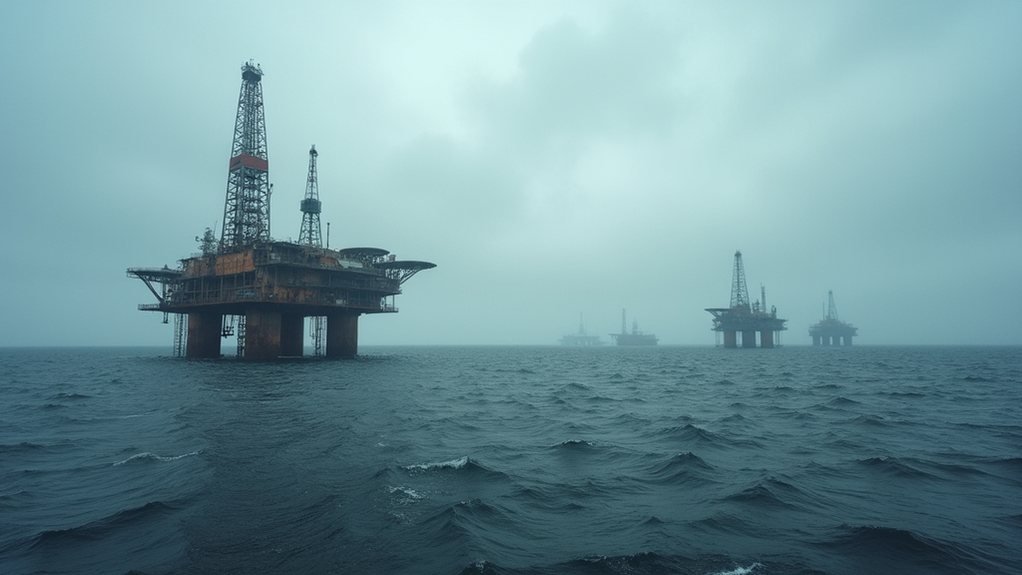

UK North Sea drilling activity has hit an unprecedented low, largely due to the Energy Profits Levy (EPL) and a significant decline in exploration licenses. The EPL, which taxes extraordinary profits, has caused major companies to tighten their belts, resulting in only a handful of wells drilled recently. This situation not only affects the UK’s energy independence but also raises concerns about local employment and reserves. Curious about how this impacts future strategies? There’s more to uncover!
Quick Overview
- UK North Sea drilling activity reached an all-time low in 2025, with zero new exploration wells drilled.
- The Energy Profits Levy (EPL) implemented in 2022 caused major companies to reduce investments in UK exploration.
- In 2024, only four wells were drilled, marking a significant decline in exploration efforts.
- UK reserves are declining, emphasizing the need for increased exploration to enhance energy independence.
- A strategic shift towards short-cycle drilling methods and strict budgets is impacting future exploration success.
Understanding the Decline in UK North Sea Drilling Activity
The year 2025 marked an historic low with zero new exploration wells, a phenomenon unseen since 1964. In stark comparison, Norway confidently drilled 33 wells, highlighting the UK’s struggles. In addition, Norway achieved 93 commercial discoveries compared to the UK’s 24, emphasizing the disparity in exploration success. Factors like the Energy Profits Levy (EPL) licence ban further dim 2026 prospects, leaving only three exploration wells on the horizon. Notably, asset uptime reported at approximately 90% underlines the stark contrast with drilling activity.
2025 witnessed an unprecedented zero new exploration wells in the UK, a stark contrast to Norway’s 33 successful drills.
The once-thriving seabed now appears less inviting, prompting a shift toward short-cycle drilling and other cost-saving strategies, like a frugal shopper at a sale. This shift coincides with reduced exploration investment, affecting long-term energy security and local employment.
How the Energy Profits Levy Is Shaping Investments
While it may seem like the Energy Profits Levy (EPL) came out of left field to shake up investments in the UK North Sea, it has actually been a carefully maneuvered bombshell in response to surging oil prices and geopolitical turmoil. Introduced in 2022, the EPL initially set a 25% tax on extraordinary profits, ramping up to 38% by 2030. This hefty charge has caused big players like TotalEnergies and Shell to slash investments. Furthermore, the decline in exploration has already led to record low activity, with only four wells drilled in 2024. Such policy shifts could also influence emission reductions trajectories as the UK aims to align energy investment with climate goals. It’s like asking a party host to pay for all the snacks—suddenly, fewer party favors are on the table, and even the independent producers might miss the fun entirely. The ring fence corporation tax exacerbates the situation by preventing loss offsets, adding pressure on companies to rethink their UK operations.
Exploration Success: UK vs. Norway
How does the exploration success of the UK stack up against its neighbor Norway? In 2024, the UK faced record-low production, with just four exploration wells drilled, while Norway continued to provide 43% of the UK’s gas supply. In line with best practice, operators should report GHG emissions across scopes to benchmark performance and encourage cleaner exploration practices. Despite the UK boasting promising reserves of 2.9 billion barrels of oil equivalent (boe) and significant near-term potential, its reliance on imports mirrors a tightening rope. Meanwhile, Norway stands strong with an established production foundation. If the UK wants to avoid a feast of LNG imports, a hearty investment in exploration is essential—a bit like buttering bread before making a sandwich. The UK’s total reserves have slightly declined year-on-year, which underscores the current reserves situation. To enhance energy independence, the UK could meet half its oil and gas needs from the North Sea, which would necessitate a proactive approach to exploration and production.