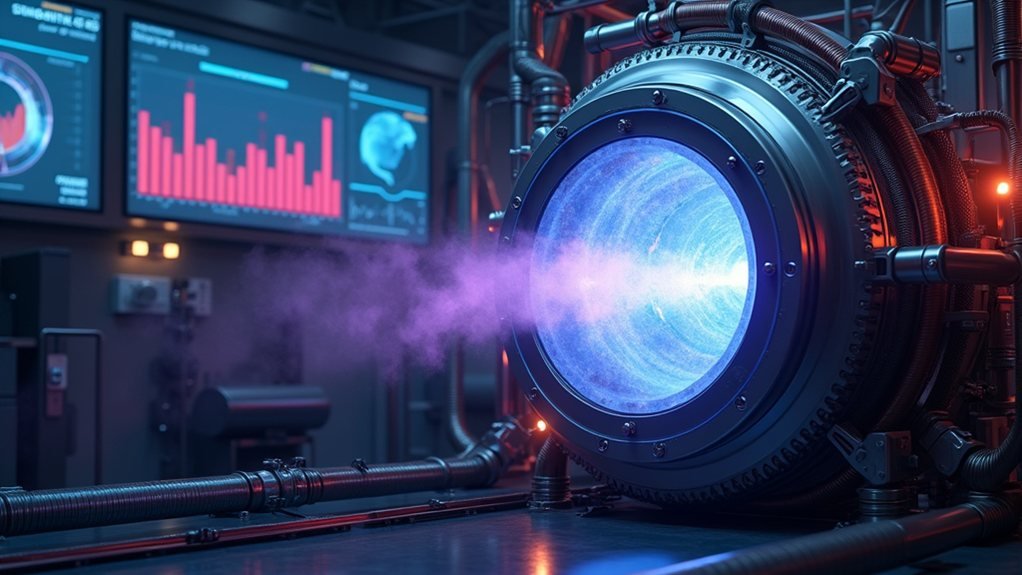

Scientists recently reached an exciting milestone in fusion energy, inching closer to a technology that could change our energy game entirely. With breakthroughs like high-temperature superconducting magnets and major advancements in tokamak reactors, the process mimics the sun to produce carbon-free energy. Fusion could offer four million times more energy than fossil fuels, with fuel sourced from seawater. Not only does this mean cleaner energy, but it also leaves behind a lighter radioactive footprint. There’s much more on this remarkable journey.
Quick Overview
- The National Ignition Facility (NIF) achieved significant progress in inertial confinement fusion, showcasing a fourfold gain in target performance in April 2025.
- The THOR platform successfully created a burning plasma, establishing a self-sustaining feedback loop crucial for achieving fusion ignition.
- Recent milestones in fusion ignition were reached at Los Alamos and Lawrence Livermore National Laboratories, enhancing the feasibility of controlled fusion energy.
- Extended plasma confinement records were achieved by France’s WEST and China’s EAST reactors, indicating advancements in reactor performance and efficiency.
- High-temperature superconducting magnets are revolutionizing fusion reactor designs, improving efficiency and compactness for future energy applications.
What Are the Key Breakthroughs in Fusion Energy?
What if the key to limitless, clean energy was just a few breakthroughs away? In the domain of fusion energy, remarkable strides are reshaping the landscape.
High-temperature superconducting magnets are shrinking reactor sizes while boosting efficiency—think a compact powerhouse on your block! Tokamaks are the most mature fusion architecture with decades of support from national programs, ensuring that they are at the forefront of this energy revolution. Furthermore, fusion energy provides abundant, carbon-free energy that mimics the sun, making it a pivotal solution for our energy needs.
Meanwhile, extended plasma confinement records from reactors like France’s WEST and China’s EAST highlight breakthroughs in maintaining ultra-hot plasma. Recent progress in material science is also improving component durability and maintenance intervals advanced materials.
And stellarators, with their inherent stability, are finally earning street cred.
With private investments surging, companies like Helion Energy are paving the way for commercial plants.
The fusion revolution is heating up, and the future looks electrifying!
How Do Recent Fusion Experiments Enhance Ignition Potential?
While the quest for fusion ignition may sound like the plot of a sci-fi blockbuster, recent experiments are turning this ambitious dream into a tangible reality.
Breakthroughs at the National Ignition Facility (NIF) demonstrate how cutting-edge techniques, like inertial confinement, achieve stunning target gains. The April 2025 experiment showcased a fourfold gain, while a burning plasma created with the THOR platform adds a self-sustaining feedback loop. Notably, ignition was achieved at Los Alamos National Laboratory and Lawrence Livermore National Laboratory, marking a significant milestone in fusion research. This achievement means that fusion energy production is now closer than ever to becoming a viable energy source.
Imagine a tiny sun igniting here on Earth—alpha particles heat the fusion fuel, making ignition more achievable. These advances not only hint at fusion’s potential but also make it feel like a thrilling ride toward energy independence. A growing interest in small modular reactors shows parallel efforts to decarbonize with emerging nuclear technologies.
Future of Fusion: Implications for Clean Energy
As the world grapples with the pressing need for cleaner energy solutions, fusion energy emerges as a beacon of hope, promising to revolutionize how power is generated.
Imagine harnessing the same force that powers the sun! Fusion delivers four million times more energy than burning fossil fuels, with an almost limitless fuel supply from seawater and lithium. Fusion requires deuterium and tritium as fuel, which can be sourced from all forms of water. It’s carbon-free, meaning it won’t add to greenhouse gases or contribute to climate change. Plus, fusion reactors are safer and produce less radioactive waste than their fission counterparts. Recent achievements in fusion energy highlight the progress being made, showcasing the potential of this technology. Renewable energy benefits such as reduced emissions and long-term resource availability position fusion alongside solar, wind, and hydro as key options for a sustainable energy mix.
As fusion technology matures, it could become the reliable energy backbone for a sustainable future.