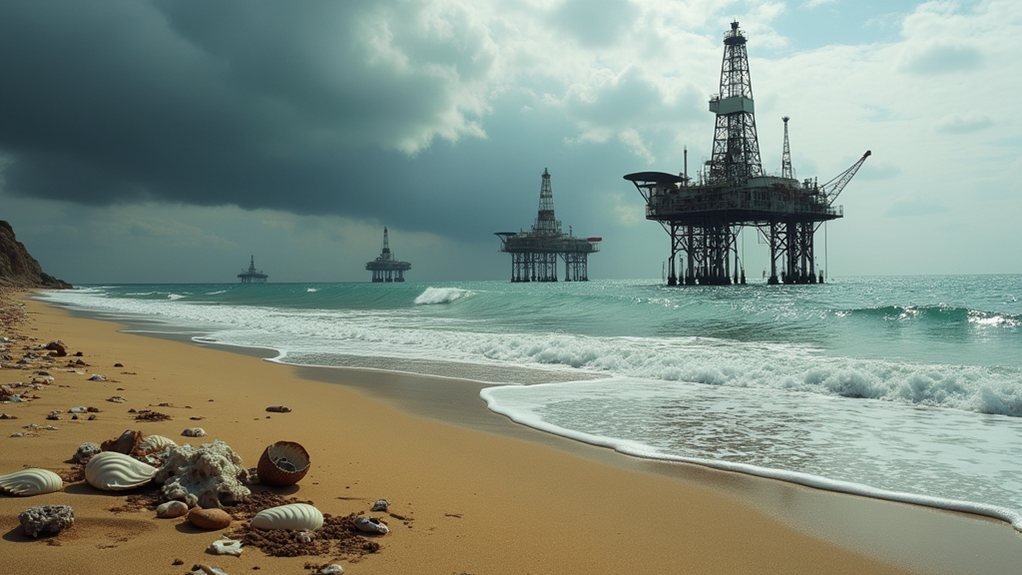
The Trump administration’s offshore drilling expansion plan is like opening Pandora’s box for marine ecosystems. With the potential for thousands of oil spills, we’re looking at serious repercussions for ocean wildlife and local economies. Imagine 1.27 billion acres of federal waters becoming a playground for oil, leading to toxin-laden messes that fishermen and beachgoers will dread. As communities rally against this, the question remains: what can be done to protect our oceans from this impending threat?
Quick Overview
- The proposal to open 1.27 billion acres for drilling increases the risk of oil spills in ecologically sensitive marine areas.
- Oil spills from offshore drilling could affect over 10,000 seabirds and nearly 26,000 marine mammals, harming biodiversity.
- Long-term ecological impacts from spills may lead to reduced populations and reproductive success for affected marine species.
- Communities dependent on fishing and recreation face economic devastation from oil spills and ongoing contamination.
- Public opposition against offshore drilling is rising, with over 300,000 comments and 400 municipalities formally expressing their discontent.
Overview of Trump’s Offshore Drilling Expansion Plan
As the sun sets on the horizon of America’s coastline, a new chapter in offshore energy exploration is about to unfold, courtesy of Trump’s ambitious Offshore Drilling Expansion Plan.
This proposal aims to authorize up to 34 oil and gas lease sales over the next five years, opening 1.27 billion acres of federal waters, including the Gulf of Mexico and California coast. It’s a significant shift, marking the first California leases since 1984. An estimated release of over 12 million gallons of crude oil into ecologically significant marine areas is anticipated as part of this extensive drilling initiative. Additionally, this plan includes over 20 lease sales in Alaska’s High Arctic through 2031, raising concerns about the impact on fragile ecosystems.
With a timeline stretching from 2026 to 2040, this plan is as bold as a surfer tackling a gnarly wave, but it also brings waves of controversy and opposition. Protecting marine biodiversity requires sustainable fisheries and other conservation strategies to reduce long-term damage.
Projected Environmental and Economic Impacts of Oil Spills From Offshore Drilling
The ripple effects of oil spills from offshore drilling extend far beyond the immediate disaster, resembling an unwelcome guest that lingers long after the party ends.
With over 10,000 seabirds and nearly 26,000 marine mammals affected by spills like the Deepwater Horizon, ecosystems take a substantial hit. Long-term ecological impacts from such spills can lead to diminished populations and compromised reproductive success in affected species. The discharge of produced water from offshore operations can further contaminate marine habitats, exacerbating the ecological damage caused by oil spills.
Imagine entire coastal marshes, once teeming with life, turning into ghost towns. Habitat protection efforts are crucial to prevent these losses and support recovery.
Economically, communities reliant on fishing and recreation suffer, as cleanup efforts often leave lingering toxins behind.
While a quick fix may appear effective, the long-term consequences can feel like a bad hangover that just won’t go away.
How Communities Are Responding to Offshore Drilling?
Communities along the coast are taking a stand against offshore drilling, fueled by the haunting aftermath of oil spills and the desire to protect their local environments and economies.
Nearly 300,000 comments highlight public discontent, while over 400 municipalities have formally opposed new drilling. Local governments, like St. Augustine and Edisto Beach, have passed resolutions against seismic blasting, echoing the sentiments of more than 2,500 elected officials. Additionally, 104 scientists have urged President Biden and Secretary Haaland to finalize a five-year plan with no new offshore drilling leases. Recent surveys show that 51% of Americans express opposition to increased offshore drilling, emphasizing the growing public support for environmental protection.
Even businesses and fishing families, totaling over 500,000, have rallied against this expansion.
With 51% of Americans expressing opposition, the coastal chorus grows louder, proving that grassroots activism isn’t just noise—it’s a symphony for change. A growing focus on environmental justice highlights how pollution and resource decisions disproportionately affect vulnerable communities.