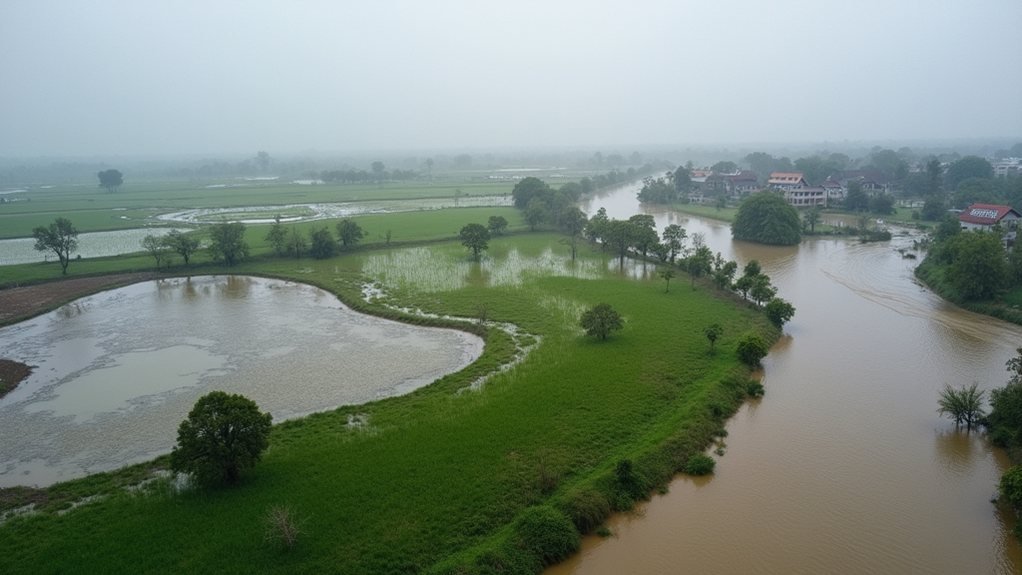

Storm Chandra brought a deluge of record-breaking rainfall to the UK, triggering widespread flooding and chaos. White Barrow in Devon soaked up a staggering 115.1 mm, while Katesbridge set a new January record at 114.8 mm. Local authorities sprang into action, forming multi-agency response teams to tackle over 1,000 weather-related incidents. With help from temporary flood barriers and community support, residents are grappling with the aftermath. Curious about how this storm has reshaped our weather? Keep on exploring!
Quick Overview
- Storm Chandra brought record rainfall, with Devon receiving 115.1 mm and Northern Ireland hitting 114.8 mm, leading to widespread flooding.
- Over 1,000 weather-related incidents were reported in Northern Ireland, while Somerset declared a major incident due to severe flooding.
- Emergency services coordinated joint responses, including multi-agency efforts in Somerset and local councils addressing flooding reports.
- Health concerns arose from urban runoff, increasing pollution levels in waterways and risks to public health and ecosystems.
- Community support included temporary flood barriers, homeowner grants, and dedicated hotlines to assist affected residents during the crisis.
Government and Community Responses to Flooding From Storm Chandra
As Storm Chandra swept across the UK, bringing with it a deluge of rain that could make even a fish feel soggy, the government and local communities sprang into action with an impressive display of coordination and support.
Multi-agency coordination cells sprang up, with key locations like Bridgwater Police Station serving as command central. Emergency services and local councils teamed up, tackling over 1,000 weather-related incidents in Northern Ireland alone. DfI teams have already responded to over 600 individual flooding reports, showcasing their commitment to addressing the crisis. In Somerset, a joint response effort involving the Environment Agency and local organizations has been pivotal in managing the ongoing flooding situation. Local authorities also began considering green infrastructure solutions to reduce future flood risk and improve urban resilience.
In the face of Storm Chandra, emergency services united to tackle over 1,000 incidents, showcasing impressive coordination and resilience.
Temporary flood barriers emerged in strategic spots, while residents received support through homeowner grants and dedicated hotlines.
This was a classic case of “many hands make light work,” even in the soggiest of conditions.
Record Rainfall From Storm Chandra: Areas Most Affected
Record rainfall from Storm Chandra has left its mark across the UK, transforming picturesque landscapes into waterlogged fields that would make even the most enthusiastic swimmer think twice.
In Devon, White Barrow topped the charts with a staggering 115.1 mm, while Dartmoor and Brookfield Farm followed closely. Northern Ireland saw Katesbridge hit 114.8 mm, setting a new daily January record. Storm Chandra caused significant rainfall totals that exceeded 60 mm in several locations, highlighting the severity of the event. The situation has escalated to a major incident in Somerset, where authorities are actively responding to the flooding crisis. Local responders are also emphasizing the importance of water conservation to protect resources and reduce long-term impacts.
Somerset declared a major incident, with flooding affecting numerous areas. The amber warnings reflected the seriousness, as saturated grounds faced further deluges.
With rain totals reaching 50-65 mm across the southwest, the UK is now a soggy maze of flooded fields.
Impact of Storm Chandra on UK Weather Patterns
The recent onslaught of Storm Chandra has not only drenched the UK but has also shaken up the usual weather routine, leaving meteorologists scratching their heads and reaching for their umbrellas. Temperatures took a nosedive post-storm, with chilly air sweeping into northern Scotland and snow forecast across higher grounds. Ground saturation from relentless rain triggered flooding alerts, with over 60 properties affected. Unusual easterly winds added a twist, making even the Isles of Scilly feel gusty. As Chandra’s remnants linger, the UK braces for further snow and frost, reminding everyone that winter is far from over—hold onto those coats! Storm Chandra has caused significant weather chaos across the UK, leading to multiple yellow weather warnings for rain. The Met Office has issued yellow weather warnings for rain, indicating increased risks of flooding. Urban runoff from saturated ground can worsen flood impacts by carrying pollutants into waterways, increasing risks to public health and ecosystems, particularly through particulate pollution.