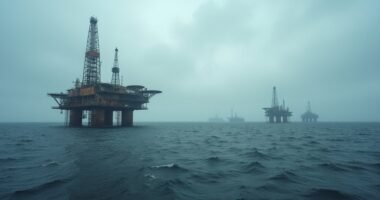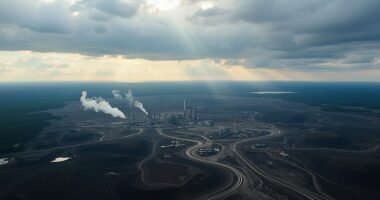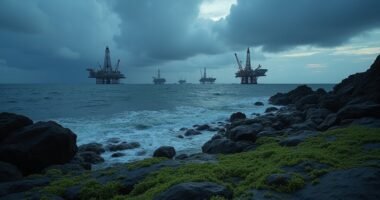
Venezuela’s oil crisis, once a booming industry, plummeted due to mismanagement, with production down by 75% since 2014. As the country revamps its Hydrocarbon Laws to invite foreign investment—lessening state royalties and enabling majority stakes—concerns rise about environmental fallout. Oil production could wreak havoc on nature, increasing emissions and spills. By 2026, the balance between profit and planet is critical. It’s like treading a tightrope over a pit of alligators—exciting, yet nerve-wracking. More insights await!
Quick Overview
- The U.S. may seek to increase oil imports from Venezuela to stabilize its energy supply amidst global market fluctuations.
- Venezuela’s oil production crisis has prompted potential U.S. interest in exploiting its vast reserves for economic gain.
- Environmental concerns arise with increased oil extraction, potentially leading to significant pollution and emissions linked to climate rollback initiatives.
- Legal reforms in Venezuela aim to attract foreign investment, potentially facilitating U.S. corporate involvement in the oil sector.
- The success of U.S. interests in Venezuela hinges on navigating both economic and environmental challenges, including infrastructure decay and climate impacts.
Understanding Venezuela’s Oil Crisis and Recovery Potential
As Venezuela finds itself mired in an oil crisis that seems to have no end in sight, one might wonder how a nation with the world’s largest proven oil reserves could hit such a rocky road.
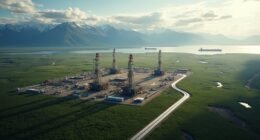
The country’s crude oil production has plummeted by about 75% since 2014, primarily due to chronic mismanagement and expropriations. Venezuela’s crude oil production is reported at 896,000 Barrel/Day th in Dec 2025, underscoring the severity of the crisis. Infrastructure is crumbling, and the heavy crude is a bear to refine. While reserves are impressive, they resemble a mirage—plentiful but hard to tap. Political stability is essential for any meaningful recovery in Venezuela’s oil sector.
Implementing sustainability methodologies across the oil supply chain could help rebuild the industry while addressing environmental concerns. With modest recovery projections, the future hinges on overcoming structural challenges and, perhaps, a dash of political will.
How Venezuela’s Hydrocarbon Law Reforms Affect Foreign Investment
While many may view Venezuela’s hydrocarbon law reforms as a mere shuffle of paperwork, these changes could very well redefine the landscape of foreign investment in the country.
By allowing private companies to hold majority stakes in joint ventures, Venezuela is breaking free from decades of state control. This shift not only invites more investment but also offers tantalizing tax breaks and direct marketing rights, making it easier for companies to operate. Moreover, with the incorporation of productive models from the Anti-Blockade Law of 2020, the reforms are set to enhance operational efficiency and attract foreign partnerships. Companies investing in Venezuela’s oil sector now have an opportunity to align their operations with sustainable development goals while pursuing profitable ventures in the region. Additionally, the reduction of state royalty share from 30% to 20% for private companies may further incentivize investors by increasing their potential profits.
With independent dispute resolution and protective legal frameworks in place, foreign investors might just find themselves dancing in the streets—or at least in the boardrooms—celebrating the newfound opportunities.
How Will Increased Oil Production Affect the Environment in 2026?
How will increased oil production in Venezuela impact the environment by 2026?
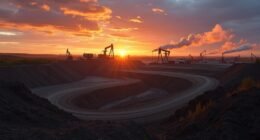
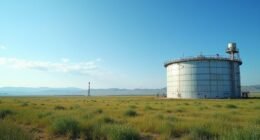
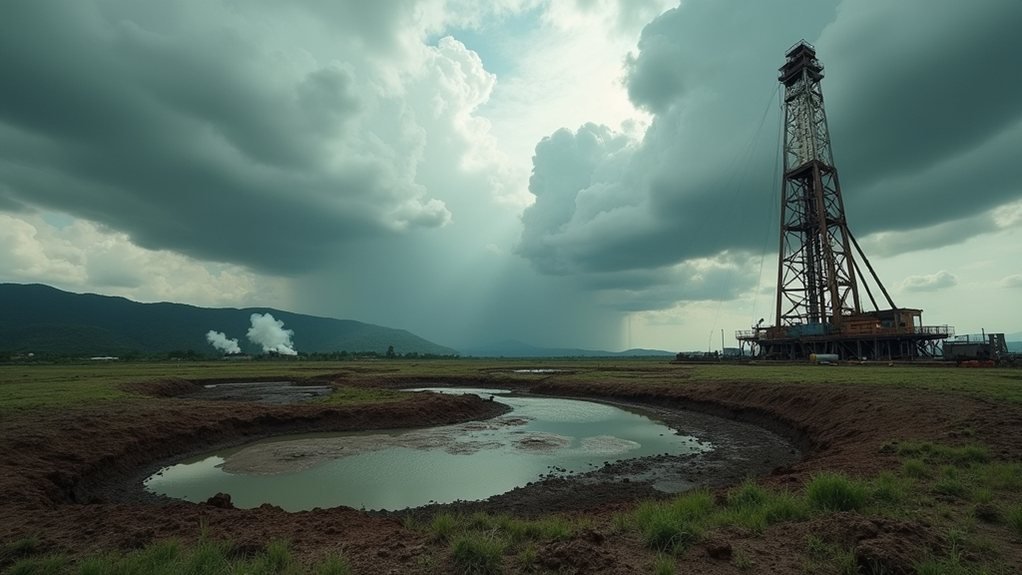
With heavy crude extraction demanding more energy, pollution levels are set to soar. Imagine a factory running on overdrive, belching out emissions—Venezuela’s aging infrastructure only amplifies this. Current infrastructure includes sinking storage facilities and broken wellheads, which will exacerbate the already critical situation. The decaying oil infrastructure will require significant investment and years of work to repair, further complicating the environmental impact.
Methane leaks and oil spills are likely to skyrocket, painting the landscape with environmental hazards. The projected rise in CO2 emissions could rival half of U.S. gasoline vehicles. Achieving blue economy principles that balance economic growth with marine ecosystem preservation will be nearly impossible under these extraction conditions.
Meanwhile, deforestation and ecosystem disruptions threaten biodiversity. Think of it as a game of environmental Jenga: one wrong move, and the whole tower—our precious planet—could come tumbling down.