The UK’s windfall tax on North Sea oil and gas currently sits at a hefty 78%, making producers feel like they’re footing the bill for an extravagant party. Many in the industry argue this quasi-confiscation dampens investment, leading to job losses and a decline in production. If discussions around an early end to this tax gather steam by 2026, it could dramatically alter the energy landscape. Curious about the potential effects on jobs and the environment?
Quick Overview
- Discussions around potential early termination of the windfall tax are ongoing, impacting oil and gas producers’ investment strategies for 2026.
- Industry leaders argue the 78% tax and increased Energy Profits Levy stifle investment and cause significant operational reassessments.
- The UK’s North Sea oil production is forecasted to decline drastically by 2035, raising concerns over energy security and job sustainability.
- Over half of Scottish voters support further development of North Sea resources, emphasizing economic growth versus immediate fiscal policies.
- Environmental and job market implications highlight the need for balanced tax policies to support both production and sustainability goals in the sector.
Understanding the Current State of the Windfall Tax
As the dust settles after the whirlwind of recent energy market changes, one might find the UK’s windfall tax on oil and gas operations both bewildering and fascinating. Currently, the tax rate hovers at a whopping 78%, thanks to an ensemble cast of levies, with the Energy Profits Levy jumping from 25% to 38%. Talk about a roller coaster! Meanwhile, the traditional corporation tax remains a mere 25%. This hefty tax burden, tripling typical UK business rates, raises eyebrows and questions about investment viability. The government aims for clarity, but investors are left balancing on a tightrope of volatility and opportunity. However, the current headline tax rate could potentially see a change if the Energy Profits Levy is ended prematurely. Notably, around 500 million BOE of potential output has slipped from company plans amid these investment cuts. Managing these fiscal uncertainties requires a thorough understanding of climate-related risks embedded in the evolving business environment.
Why the Industry Wants to Scrap the Windfall Tax?
Why does the energy sector view the windfall tax as a formidable foe? The 78% tax on oil and gas profits feels like a financial ninja attack, with producers claiming it’s nearly confiscatory. This environmental challenge creates tension as industries balance profit with sustainable practices.
Investment has taken a nosedive—Harbour Energy nearly wiped out its profits and shelved projects. Companies like BP, Shell, and Chevron are reassessing their UK commitments. EPL concerns about the levy’s sustainability have heightened, further complicating future investments.
The tax’s consequences ripple through the workforce, with projections showing tens of thousands of job losses. Ironically, this tax may backfire by increasing global carbon emissions, undermining net-zero goals.
It’s like trying to solve a puzzle with missing pieces; the outcome just doesn’t add up.
Future of North Sea Oil Amidst Windfall Tax
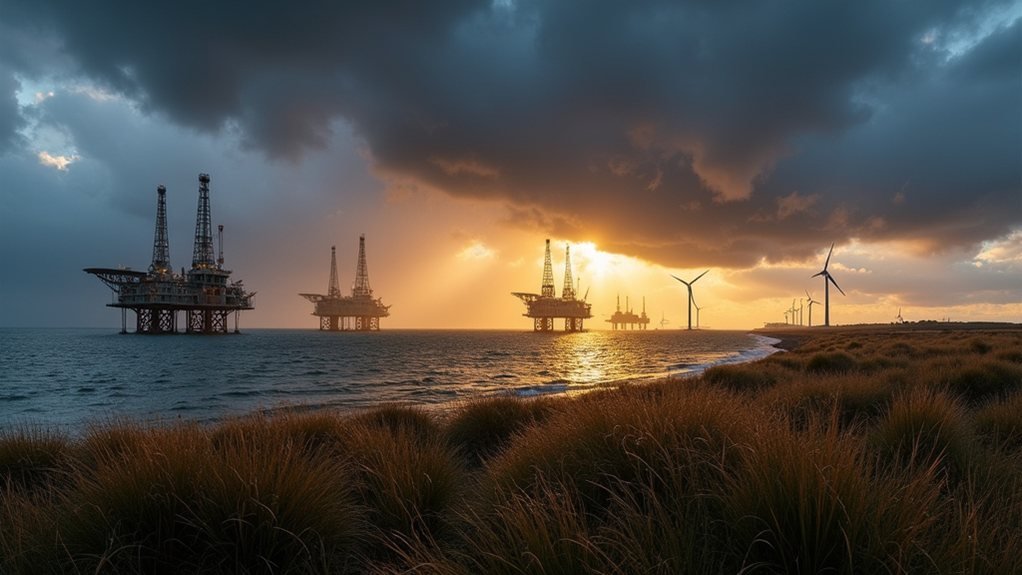
While the UK energy sector grapples with the looming specter of the windfall tax, the future of North Sea oil hangs in a delicate balance, much like a tightrope walker negotiating a gusty wind. Efficient water management within extraction processes could play a role in minimizing environmental impacts.
The industry faces a significant production decline, with output projected to plummet 78% by 2035. Yet, a hidden treasure of 7.5 billion barrels remains untapped beneath the waves. Domestic production could potentially yield an economic value of £165 billion, underscoring its importance. As 58% of Scottish voters favor full development of these resources, supporting 200,000 jobs, domestic production is essential for energy security and lower emissions.
A staggering 78% decline in North Sea output is expected by 2035, raising urgent questions for the energy sector’s future.
As the debate continues, balancing tax structures with potential economic benefits will determine if the North Sea can weather the storm—or take a dive.