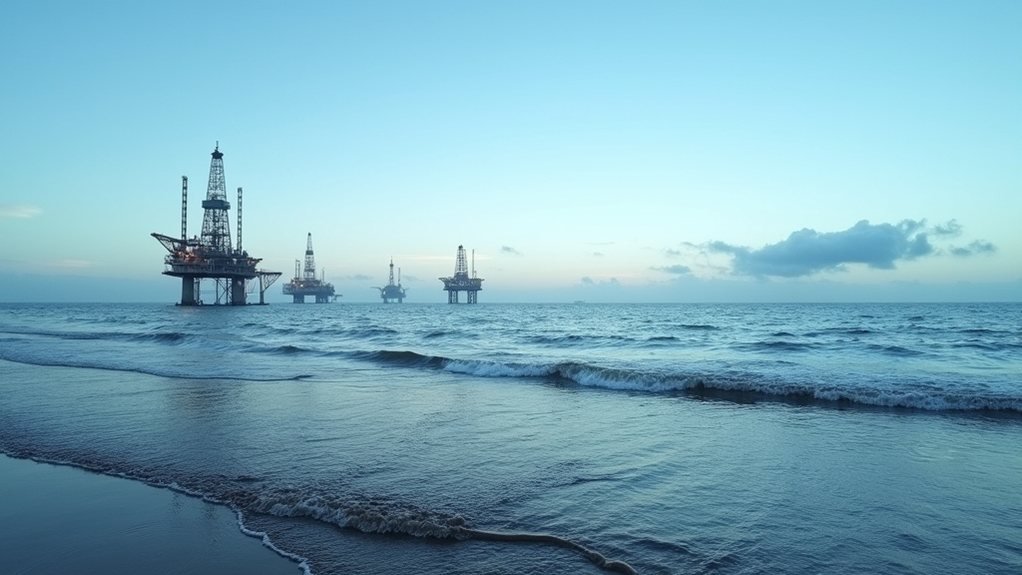

Trump’s offshore drilling plan forecasts a staggering 4,232 oil spills, stirring up a cocktail of environmental anxiety. Picture the Gulf of Mexico as the spill hotspot, with its vulnerable wildlife at risk. Cleanup? It’s like trying to catch smoke with your hands. Tools like booms and skimmers capture only a fraction of the mess, leaving ecosystems to suffer long-term damage. The balance between economic gains and ecological safety is delicate—buckle up for more insights on this tricky terrain!
Quick Overview
- Trump’s offshore drilling plan predicts over 4,000 oil spills, predominantly in the Gulf of Mexico, posing significant environmental risks.
- The projected spills could result in 12.1 million gallons of oil contamination, impacting marine ecosystems and local economies.
- Cleanup challenges are severe, with recovery efforts capturing only a small fraction of spilled oil, hindering effective remediation.
- Vulnerable species, such as the beluga whale, face heightened risks from increased drilling activities and potential spills in sensitive areas.
- The balance between economic benefits from offshore drilling and the environmental costs underscores the need for strict safety protocols and marine protection.
Why 4,232 Projected Oil Spills Demand Urgent Attention
As the ink dries on Trump’s ambitious offshore drilling plan, one can’t help but raise an eyebrow at the staggering projection of 4,232 oil spills, a number that demands urgent attention.
This figure, based on historical data, suggests a potential 12.1 million gallons of oil could taint our oceans. While it sounds like a tragic sequel to “Finding Nemo,” the reality is far grimmer. The projections exclude catastrophic events like Deepwater Horizon and tanker spills, making them likely underestimates. With over half of these spills expected in the Gulf of Mexico, the stakes couldn’t be higher for marine ecosystems and coastal communities. Additionally, the increased extraction is linked to greenhouse gas emissions, which could exacerbate climate change impacts on ocean health. Furthermore, the new drilling projects threaten not only wildlife but also the livelihoods of those who depend on healthy coastal environments. Effective marine protection strategies, such as sustainable fisheries management and targeted conservation measures, would be crucial to reduce the long-term impacts on ocean health.
Identifying the Most Vulnerable Regions to Oil Spills
While the allure of offshore drilling might dazzle some with promises of economic gain, a closer look reveals a troubling reality: certain regions are particularly prone to oil spills.
The Gulf of Mexico, already brimming with oil infrastructure, is a spill hotspot, with over half of projected incidents likely to occur there. Furthermore, the Center for Biological Diversity’s analysis predicts over 4,000 oil spills in U.S. waters, underscoring the serious risks involved.
The Gulf of Mexico stands as a spill hotspot, with more than half of projected oil incidents expected to unfold there.
Meanwhile, Alaska’s Arctic waters present a formidable cleanup challenge, threatening vulnerable species like the beluga whale. Protecting upstream areas of watersheds helps reduce pollution entering coastal and marine environments.
The Great Lakes, too, face risks from aging pipelines that transport vast amounts of crude oil, raising concerns about their environmental safety.
These areas are like ticking time bombs, reminding us that economic gain can come at an environmental cost we can’t afford to ignore.
What Are the Cleanup Challenges and Environmental Risks?
Cleanup challenges and environmental risks associated with oil spills are like a complex puzzle that never seems to fit together quite right. Different water types and conditions make oil behave unpredictably, complicating recovery efforts. While floating booms and skimmers assist, they often recover only a fraction of the spill. Dispersants can help break down oil, yet their effectiveness varies and raises health concerns for workers. Ecosystems suffer long-term damage, as seen with the Deepwater Horizon spill, where an estimated 3.19 million barrels of oil leaked into the Gulf of Mexico. In the end, the quest for effective cleanup feels like trying to catch smoke with bare hands—frustrating and elusive. The implementation of stricter safety protocols has been crucial in reducing the occurrence of major spills, yet operational spills continue to pose significant risks. Prevention and reuse remain at the top of the waste management hierarchy as the most effective strategies for reducing environmental harm, emphasizing source reduction.