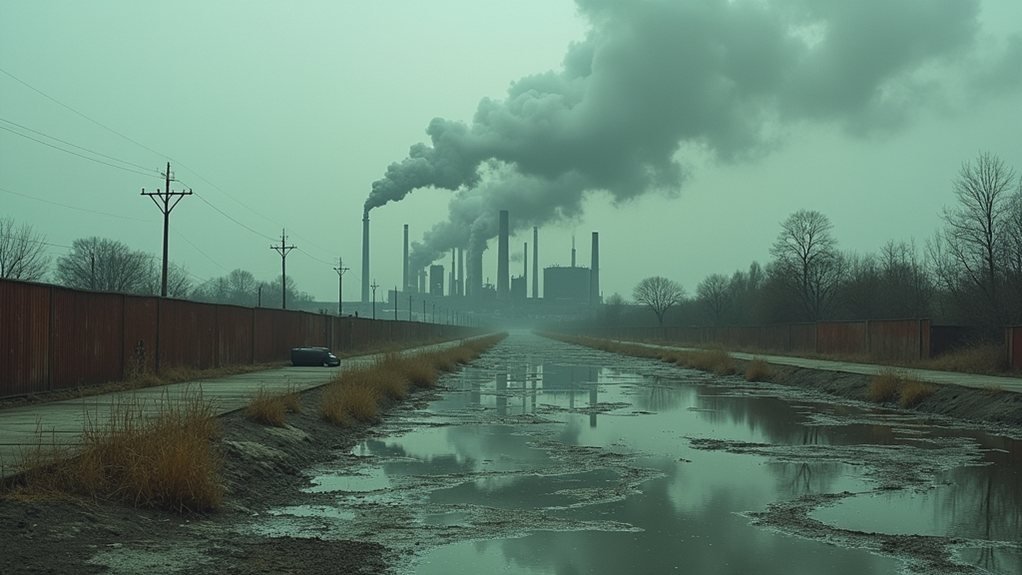

The Trump administration’s decision to loosen chemical exposure safeguards might seem like a recipe for disaster—especially when we consider the notorious PFAS, those persistent “forever chemicals” that refuse to decay. These deregulatory moves could lead to public health risks akin to leaving a gate open at a petting zoo: chaos and unpredictability. By 2026, states face the formidable task of crafting defenses against these lurking chemical threats. Want to know what happens next? You’re in the right place!
Quick Overview
- The Trump administration’s deregulation efforts reduced reporting of PFAS under TSCA, risking public health by weakening chemical exposure safeguards.
- Plans to delay compliance timelines for detecting hazardous PFAS in drinking water could increase public health risks by 2026.
- Deregulation has sparked state-led initiatives to create their own safeguards against the health risks posed by PFAS contamination.
- Community advocacy groups and environmental organizations have mobilized to combat reduced oversight and promote stronger chemical safety regulations.
- Ongoing deregulatory policies may lead to increased chemical exposure risks, threatening public health for millions of Americans by 2026.
What Is PFAS Deregulation and Why Does It Matter?
While the topic of PFAS deregulation might not light up a room like a sensational news story, it’s a conversation worth having, particularly for those interested in the intersection of environmental safety and regulatory policy. PFAS, quirky compounds known as “forever chemicals” due to their resistance to natural decay, have embedded themselves in goods since the 1940s. The creation and use of safer chemical ingredients in everyday products is becoming more prevalent as industries aim to reduce environmental impact and improve public safety. The current deregulatory efforts include tweaks to PFAS reporting under TSCA, pushing out the compliance timeline for detecting PFOA and PFOS in drinking water. Despite Trump’s administration aiming to soften existing rules, progress has been delayed, and as a result, states are formulating their own strategies to safeguard public health. These moves, expected to culminate in 2026, have sparked a tapestry of state responses, each stitching their own environmental safeguards. Notably, as part of outreach efforts, the PFAS OUTreach Initiative was launched to connect public water systems needing upgrades, with a focus on systems contaminated by PFOA and PFOS.
How Deregulation Risks Public Health and Safety
Like letting a clumsy bull loose in a china shop, deregulatory efforts risk smashing through the fragile yet essential safeguards designed to protect public health and safety. The new EPA proposal swings a pandora’s box open by cutting down on reporting requirements, much like ignoring vital backup vocals in a band. The Trump administration committed to widespread deregulation affecting health and safety, issuing executive orders to eliminate rules deemed “unlawful.” The principles of green chemistry, which include designing chemical products and processes that inherently minimize hazardous substances, are essential for safer industrial practices. As a result, chemical regulation developments face uncertainty, as the Trump Administration has extended comment periods and initiated reviews of chemical risk assessments. Ah, the “gold standard science” approach—where evaluations proceed with all the enthusiasm of an inseparable trio missing its third member—complete data.
Using Our Voice: How Communities Are Fighting Back
Deregulation may have let loose its chaotic dance, risking safety for the sake of industry, but the communities aren’t simply waiting in the wings—they’re starting to take the stage. Advocacy campaigns drum the rhythm of resistance: Waterkeeper Alliance chants to bolster the Clean Water Act, while Earthjustice partners with allies to sue for stronger safeguards. Microplastics contribute significantly to environmental pollution, posing environmental and health effects that demand urgent attention from policymakers. Communities living near industrial chemical facilities—over 177 million Americans—face increased threats to safety as chemical exposure safeguards are weakened. Texas voices, from Sierra Club Lone Star to Air Alliance Houston, echo demand for accountability amidst frequent chemical calamities. The U.S. Department of Agriculture has also been directed to prioritize chemical production, increasing exposure risks for communities nationwide. As another leak ticks down in Houston, they warn: it’s not just atmospheric jazz. This ensemble, knitting science and activism, aims to turn the industry’s solo into a duet with health.