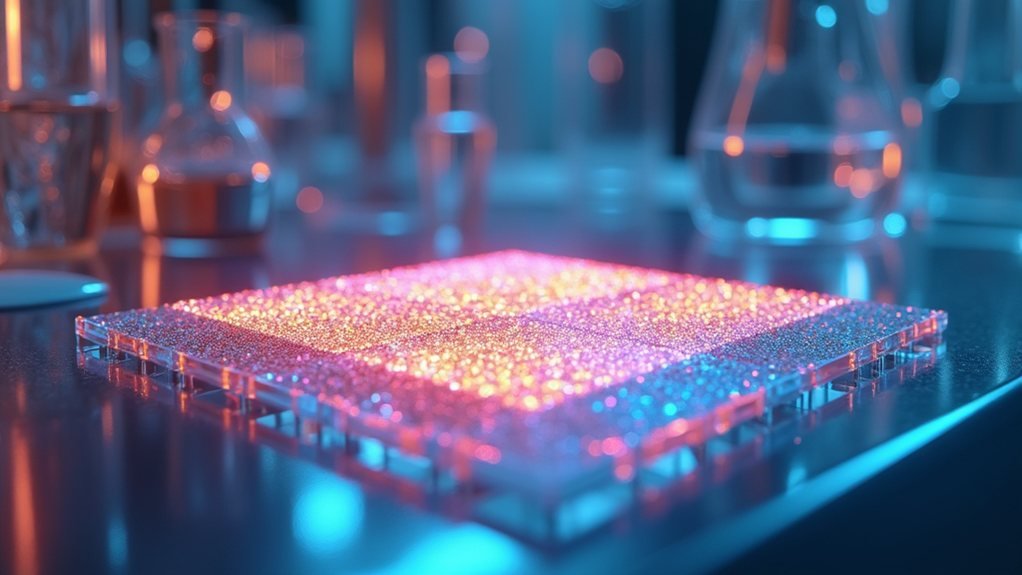

A US lab has hit a remarkable milestone with perovskite solar cells, achieving an efficiency rate of 25.4%. This breakthrough not only edges closer to silicon’s top efficiencies but also showcases the potential for cheaper, lighter, and more flexible solar technology. Think of it as the new superhero of solar energy—better performance without the cape. With stability improvements poised to tackle durability issues, this could signal a bright future for renewable energy solutions. Discover what this means for our energy landscape!
Quick Overview
- A US lab has achieved a record efficiency of 25.4% for perovskite solar cells, marking a significant breakthrough in renewable energy technology.
- This efficiency surpasses previous records for single-junction perovskite cells and is nearing silicon’s top efficiencies.
- The milestone was certified by the National Institute of Metrology of China, validating its significance in the solar industry.
- Innovations in materials and design have contributed to remarkable efficiency gains and enhanced durability of perovskite cells.
- The advancements promise to make solar energy more affordable, reliable, and widely adopted in urban environments.
Why Is 25.4% Efficiency in Perovskite Cells a Big Deal?
Why is the recent achievement of 25.4% efficiency in perovskite solar cells such a game changer? This milestone surpasses previous records for single-junction perovskites, approaching silicon’s top efficiencies.
Certified by the National Institute of Metrology of China, it signals a tipping point where lab innovations could outshine commercial silicon modules. With a 4 cm mini-module boasting 24.2% efficiency, perovskites are not just a flash in the pan—they could revolutionize solar energy. They’re cheaper, lighter, and more flexible than silicon, promising higher energy yields without the rigidity. Recent advancements in the stability of these cells, particularly through the use of amidinium ligands, enhance their durability under challenging conditions. This research also achieved over 95% efficiency retention after prolonged testing at elevated temperatures, underscoring the robust potential of perovskite technology.
This certification marks a pivotal moment where lab breakthroughs may surpass traditional silicon solar technology.
Grid integration advances mean such high-efficiency panels could be deployed more seamlessly into modern electrical systems. Imagine a solar panel so efficient it could light up your entire neighborhood’s holiday cheer!
Innovative Technologies Driving Record Performance
As researchers continue to push the boundaries of solar technology, innovative breakthroughs are lighting up the path to record efficiencies in perovskite cells.
Single-junction cells now boast efficiencies of 27.87%, thanks to advanced materials like rubidium, which stabilize the structure. Notably, SolaEon achieved a 27.87% power conversion efficiency for a single-junction perovskite solar cell, setting a new world record for this device category.
Meanwhile, tandem perovskite-silicon cells have reached 34.85%, combining the best of both worlds. This achievement highlights the potential of tandem solar cells to push efficiencies even closer to theoretical limits.
Excitingly, triple-junction cells are stepping up with 27.06% efficiency from clever design tweaks.
These advancements don’t just enhance performance; they promise a future where solar energy is as reliable as your morning coffee—essential and energizing!
Who knew sunlight could be so productive?
Additionally, combining different renewable sources with solar can improve overall system reliability by providing complementary generation.
Future Implications of Efficiency Gains in Solar Energy
With the rapid advancements in solar technology, the future of energy generation is beginning to look as bright as a sun-soaked summer day.
Perovskite solar cells, boasting efficiencies over 25%, promise to revolutionize energy production. Imagine a world where flexible, lightweight panels adorn rooftops and urban windows, turning buildings into powerhouses. Durability issues limit the commercialization of PSC technology, but ongoing research is addressing these challenges. Cost reductions from innovative manufacturing make solar not just efficient but affordable too. Bifacial solar modules could further enhance energy outputs, making the competition for sunlight fiercer than a game of musical chairs. Policymakers and industry are increasingly supporting renewable energy deployment to accelerate this transition.
As these technologies mature, solar energy may soon become the star of the renewable energy show—sustainable and stylish.