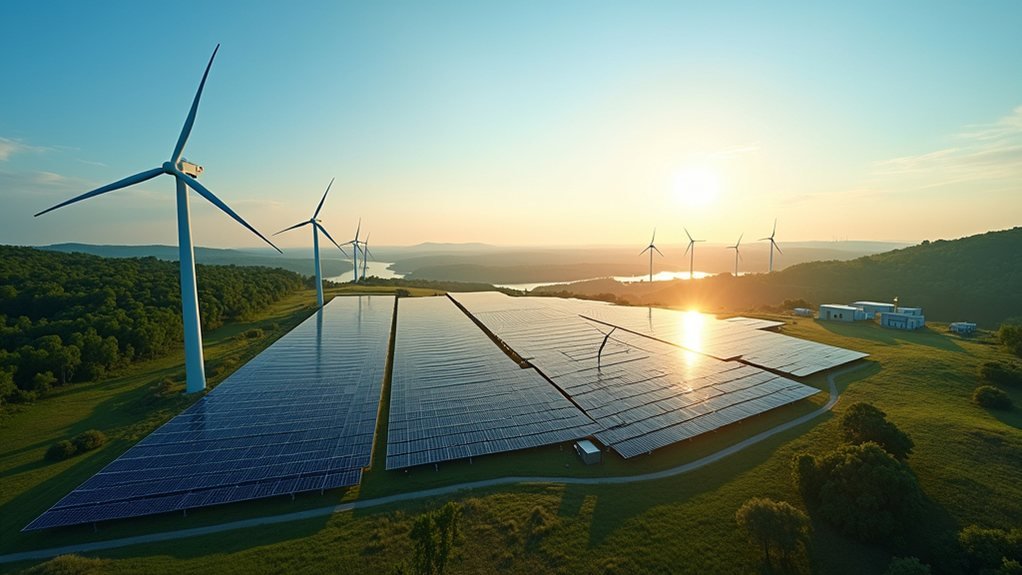

A staggering $2.3 trillion is now pouring into climate solutions, marking a watershed moment for green tech and clean energy. Solar and wind power grab a hefty slice of this investment pie, showcasing their growing dominance. Big names like Microsoft are getting cozy with clean energy contracts, while battery storage is on track to stabilize our grids. As global leaders band together for net-zero goals, this investment surge is just the tip of the iceberg, hinting at even more exciting developments ahead.
Quick Overview
- Clean tech investments reached a record $2.3 trillion, with solar and wind capturing the majority of funding.
- The U.S. leads in renewables, contributing to 93% of global capacity growth.
- Battery storage investments are rapidly increasing, crucial for grid stability and renewable integration.
- Corporate demand for clean energy contracts is driving significant investment in green technologies.
- Global collaboration and balanced policies are essential for achieving net-zero goals and mobilizing finance for clean solutions.
Key Investment Trends in Clean Energy
As clean energy investment continues to surge, it’s evident that the landscape is transforming faster than a teenager’s taste in music. A whopping $1.8 trillion poured into clean tech in 2025, with solar and wind leading the charge, capturing 62% of the pie.
In the U.S., renewables accounted for 93% of capacity growth, with solar and storage hogging 83%. While solar generation is expected to grow over 17% next year, a slowdown in China hints at industry consolidation. Additionally, NextEra Energy is making significant strides in renewable energy production, contributing to the overall growth trend. Furthermore, natural capital investments are projected to triple by 2030, highlighting the increasing focus on sustainable solutions.
Battery technology and grid modernization are key enablers for higher renewable penetration, and utilities are increasingly investing in advanced grid technologies to integrate variable resources. Meanwhile, battery storage costs have plummeted, making solar-plus-storage the go-to choice, particularly for tech giants craving clean power for their data centers.
Who’s Driving the Energy Transition?
Who’s really steering the ship in the energy shift? A blend of global leaders, industry CEOs, policymakers, and tech innovators are charting the course toward a sustainable future.
Ed Miliband and Mohammed Al Ramahi showcase bold net-zero visions, while Arvinder Singh Sahney emphasizes natural gas’s role in the transformation. International Energy Week 2026 aims to convene these influential figures to discuss strategies for achieving net-zero goals. Leaders stressed the importance of pragmatic transition pathways to ensure a balanced approach.
Governments advocate for balanced policies to harmonize economic growth with climate goals. Renewable deployment requires careful planning to integrate grid modernization and storage solutions.
Meanwhile, tech giants like Microsoft lead the charge in procuring clean energy, proving that collaboration is key.
Together, these players are not just talking the talk; they’re walking the walk, ensuring the energy transformation isn’t just a pipe dream.
Emerging Trends Shaping Future Clean Energy Investments
In the ever-evolving landscape of clean energy investments, new trends are emerging that promise to reshape the way we generate and consume power. Solar PV is leading the charge, expected to dominate half of cleantech investments by 2025, while battery storage is doubling up to stabilize the grid. Meanwhile, AI is transforming energy management like a savvy friend organizing a chaotic closet. Investments are projected to reach nearly $670 billion by 2025, indicating a robust commitment to clean energy solutions. As the landscape shifts from experimenting to execution, corporate giants are fueling demand, with tech firms securing vast clean energy contracts. Though green hydrogen is taking a breather, CCUS is stepping up for heavy industry. Together, these trends are crafting a cleaner, more efficient energy future. Global policy commitments at forums like COP29 are helping to align national strategies and mobilize finance for these technologies, supporting accelerated deployment.