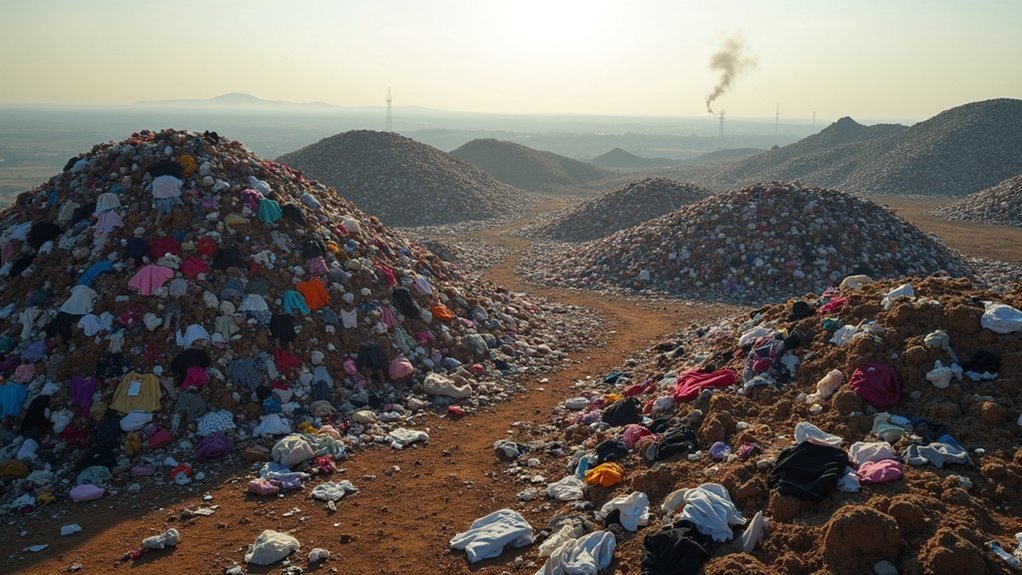

Fast fashion might have your closet looking fresh, but it’s costing the planet big time! This industry pumps out a staggering 944 million metric tons of carbon emissions each year and guzzles 79 billion cubic meters of water — enough to quench the thirst of 5 million people! Add to that the 92–120 million tonnes of textile waste tossed away annually, and it’s clear: cheap clothes come with a hefty price tag. Stick around to uncover more about this fashion fiasco.
Quick Overview
- Fast fashion contributes significantly to global carbon emissions, with 2023 figures at 944 million metric tons, projected to rise by 2030.
- The industry is the second-largest water consumer, using 79 billion cubic meters, impacting water availability and ecosystems.
- Approximately 92–120 million tonnes of textiles are discarded annually, with less than 1% recycled into new garments.
- Synthetic fibers complicate recycling efforts, leading to increased landfill and incinerator waste from discarded clothing.
- Conscious consumption habits and renewable energy adoption in supply chains are crucial for mitigating fashion’s environmental impact.
The Environmental Impact of Carbon Emissions in Fashion
In 2023, the fashion industry released a staggering 944 million metric tons of carbon emissions into the atmosphere, which is like dumping the weight of 200 million hippos into a pool—except this pool is our planet!
Contributing 1.78% to 10% of global emissions, the sector is a heavyweight contender in the climate crisis. Over 70% of these emissions stem from upstream activities, like producing virgin polyester, which guzzles oil and energy. Apparel sector greenhouse gas emissions increased by 7.5% compared to 2022, highlighting the urgent need for change. This is the first year-on-year increase since tracking began in 2019.
If trends continue, emissions could swell to 1.253 billion metric tons by 2030. Fashion’s carbon footprint is expanding faster than the latest ultra-fast fashion trend—time for a serious wardrobe rethink! Transitioning to renewable energy sources throughout the supply chain represents one of the most effective strategies to slash the industry’s carbon footprint.
Water Consumption and Its Consequences
While many may think of fashion as a fun way to express individuality, the industry’s staggering appetite for water tells a different story.
Ranking as the second-largest water consumer, fashion uses a whopping 79 billion cubic meters annually—enough to meet the needs of 5 million people! Additionally, 2.7 billion people currently face water scarcity, highlighting the urgent need for change.
Fashion’s staggering water consumption of 79 billion cubic meters annually could sustain 5 million people.
For instance, producing a single cotton t-shirt drinks up 2,700 liters, equivalent to one person’s drinking water for 900 days.
Cotton farming not only depletes water sources but also contaminates ecosystems with fertilizers and pesticides. Textile dyeing and finishing alone account for over 20% of global industrial water pollution, exacerbating the environmental crisis.
As fast fashion flourishes, the thirst for water grows, threatening both people and the planet. Understanding both direct and indirect water usage is essential for developing effective reduction strategies in the fashion industry.
The Alarming Rise of Textile Waste
Textile waste has emerged as a colossal challenge in the fashion industry, resembling a fashionista’s nightmare closet overstuffed with unworn clothes. Each year, approximately 92–120 million tonnes of textiles are discarded, fueled by the production of up to 100 billion garments. While high-income countries average about 95.7 pounds of waste per person annually, many of these discarded items find their way to landfills or incinerators, with less than 1% recycled into new garments. Only about 20% of textile waste is collected for reuse or recycling globally, making the situation even more dire as synthetic fibers dominate, recycling becomes trickier, leading to a scenario where the planet pays the price for our shopping sprees. It’s a costly, toxic cycle. The alarming reality is that the fashion industry is responsible for a significant portion of global environmental degradation through its waste and pollution. Embracing conscious consumption habits can help individuals reduce their contribution to this mounting textile waste crisis.