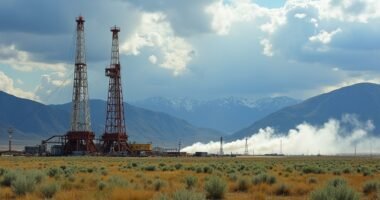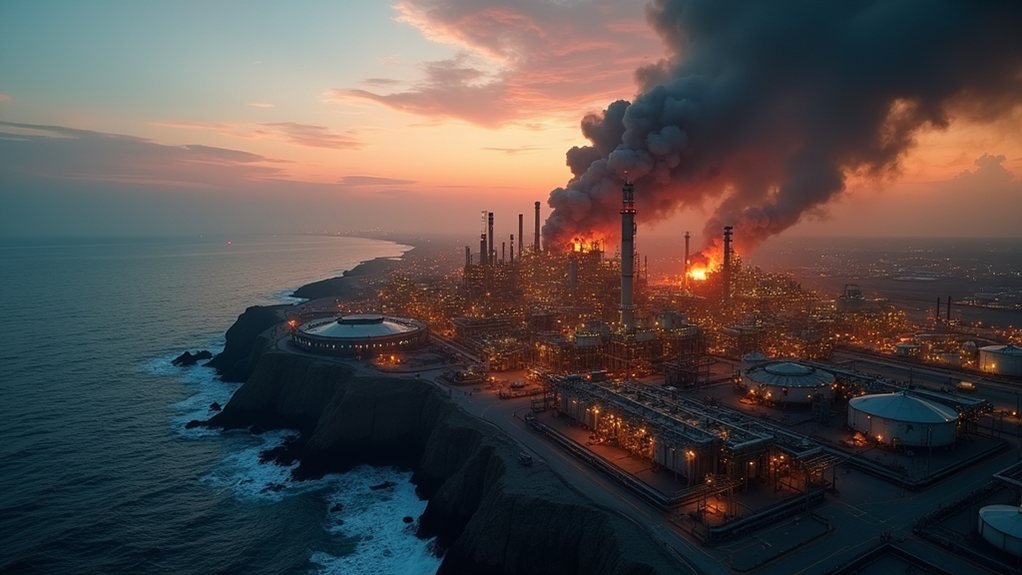

The recent US-Israel strikes on Iran have set off alarm bells regarding the stability of Iran’s oil industry and the global energy market. With Iran pumping out around 3.1 million barrels of oil each day, disruptions could send prices soaring—some analysts predict they might spike to $80, or even beyond $90 if tensions escalate. This rollercoaster isn’t just about prices; it could rattle the entire regional oil supply chain, leaving everyone wondering what happens next. Curious about the unfolding drama?
Quick Overview
- The US-Israel strikes threaten Iran’s oil production, risking crucial revenue given Iran’s daily output of 3.1 million barrels.
- Analysts predict fluctuations in global oil prices, potentially reaching $80 per barrel due to heightened US-Iran tensions.
- Strikes may disrupt the logistical stability of regional oil supply, raising fears of retaliatory attacks on Gulf infrastructure.
- Navigational dangers in the Strait of Hormuz, crucial for oil transport, heighten risks for six oil-producing states reliant on secure passage.
- Environmental and human consequences follow the strikes, with over 200 fatalities reported, further destabilizing regions reliant on oil supply stability.
How Have US-Israel Strikes Impacted Iran’s Oil Industry?
As tensions flared in the Middle East, one couldn’t help but wonder how the recent US-Israel strikes would reverberate through Iran’s oil industry, a critical pillar of the nation’s economy.
Iran, producing 3.1 million barrels daily, maintains its strategic role despite sanctions. Yet, these targeted strikes threaten stability, raising security alarms. Analysts predict significant oil market volatility following the large-scale strikes. Furthermore, the prospect of Iran’s Revolutionary Guard Corps’ dismantlement adds further uncertainty to the already precarious situation. Accurate greenhouse gas measurement by Iran’s oil sector could also be affected, influencing global environmental reporting obligations.
Iran’s oil production remains crucial, yet targeted strikes imperil stability and raise security concerns.
The historic vulnerability of the Strait of Hormuz poses risks, with Iran’s Revolutionary Guards warning of navigational dangers.
While Iran’s oil exports flow mainly to China, any disruption could choke revenue streams, turning an essential resource into a liability just as quickly as you can say “sanctions.”
How Do Strikes Influence Global Oil Prices?
Strikes in the Middle East can send shockwaves through global oil prices, often faster than a text message can be delivered. When tensions rise, investors fear disruptions, leading to immediate price surges. For instance, Brent crude recently hit $72.87 due to war worries, with projections climbing to $80 if US-Iran hostilities escalate. Oil markets expect price swings next week due to these developments. Limited strikes alone can pump prices up by $5-$10 per barrel. If shipping through the essential Strait of Hormuz is threatened, expect prices to soar beyond $90. This is particularly concerning as six oil-producing states rely heavily on this narrow passage for their oil exports, elevating the risk for global supply. It is important to consider how these environmental disruptions can also exacerbate environmental justice challenges for vulnerable communities. In oil markets, a whisper can turn into a shout—every strike rings loud across the globe, affecting wallets everywhere.
What Are the Implications for Regional Oil Supply Security?
While tensions simmer in the Middle East, the implications for regional oil supply security become increasingly precarious. The barrage of strikes on Iranian military and oil facilities poses serious risks to the stability of oil logistics. Should Iran retaliate, the threat to Gulf oil infrastructure is palpable, potentially mimicking the chaos of a bad game of Jenga. Promoting sustainable ocean practices can help mitigate some of the risks by ensuring long-term resilience of marine-based energy supply chains. As February 2026 saw coordinated airstrikes on Iran’s military sites, a misstep in this high-stakes scenario could send oil supplies spiraling. As global powers engage in this strategic chess game, the fate of oil production hangs in the balance, highlighting the fragility of energy security in an already volatile region. The impact of the attacks has already resulted in over 200 fatalities, raising concerns about the stability of oil supply chains and potential disruptions.