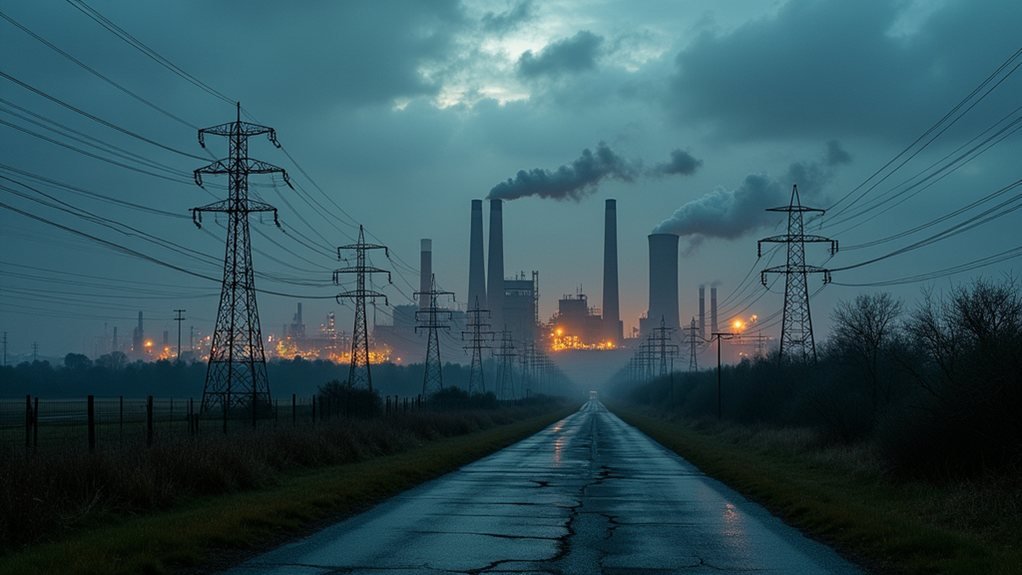

Rising industrial loads, fueled by the booming data center sector and the electrification of processes, are pushing our power grid to its limits. This surge is like a teenager outgrowing their favorite sweater—simply too tight! With demand expected to skyrocket, especially as data centers gobble up electricity, the grid’s reliability is increasingly at risk. Yet, it’s not all doom and gloom; innovative solutions are on the horizon that could help keep the lights on. Curious about how?
Quick Overview
- Peak demand is expected to rise by 166 GW in five years, straining the power grid significantly.
- Data centers alone are projected to consume 90 GW, exacerbating local grid challenges.
- Aging infrastructure struggles to accommodate increased loads from industrial electrification and electric vehicles.
- Limited transmission construction in regions like Texas threatens grid reliability and efficiency.
- Innovative solutions, such as microgrids and energy storage, are essential to mitigate strain on the power grid.
How Rising Industrial Load Affects Our Power Grid
As the world races towards a more industrialized future, the power grid finds itself in a bit of a pickle—like an overstuffed sandwich that’s about to burst at the seams.
With peak demand growth forecasted to skyrocket by 166 GW over the next five years, the grid feels the strain. Recent IEA projections indicate accelerating electricity demand driven by industrial and data center expansion.
Peak demand is set to surge by 166 GW in five years, leaving the grid under immense strain.
Significantly, data centers alone are expected to gobble up a staggering 90 GW, putting local grids under immense pressure. Data centres are projected to drive nearly 10% of global electricity demand growth by 2030, further compounding the challenges faced by energy providers.
Industrial loads are sprouting up across regions like Texas and the Southeast, but with low transmission construction, reliability is in jeopardy.
It’s a recipe for chaos unless everyone brings their best game to the table.
Drivers of Industrial Electrification
In a world where innovation and efficiency reign supreme, industrial electrification emerges as a pivotal force reshaping the landscape of energy consumption. The demand from data centers, particularly those harnessing AI, is skyrocketing—projected to hit 176 gigawatts by 2035! Meanwhile, manufacturers are electrifying processes to boost efficiency and cut costs. This transition is largely driven by the adoption of clean operational systems that enhance energy efficiency and reduce reliance on fossil fuels. As domestic content requirements become essential, companies are focusing on local production to meet compliance and boost competitiveness. Even transportation is getting in on the action, with electric vehicle sales surging. Regions like the Pacific Northwest are experiencing energy demand growth from various sources, including semiconductor manufacturing and green hydrogen. It’s a dizzying dance of electrification, promising both challenges and opportunities for the power grid ahead. The shift toward renewables and distributed generation is accelerating system transformation across grids.
Mitigating Grid Strain: Strategies for Industry
Steering through the turbulent waters of increased industrial electrification calls for sharp strategies to mitigate the strain on our aging power grid. Upgrading high-voltage lines with advanced conductors boosts efficiency while easing thermal stress—think of it as giving the grid a much-needed spa day. Expanding HVDC corridors enhances flexibility, integrating renewable energy like a perfect puzzle piece. Modernizing distribution systems with real-time monitoring guarantees utilities dance smoothly with demand. Meanwhile, deploying localized microgrids and energy storage acts like putting a safety net under a tightrope walker. Together, these strategies promise to keep the lights on without blowing a fuse. Additionally, enhancing power distribution resiliency through circuit surveys and facility upgrades ensures that utilities can effectively respond to increased load demands. The use of improved insulation and efficient building systems can reduce peak facility demand, easing stress on distribution networks. The integration of decentralized energy resources into the grid further strengthens its resilience against rising industrial loads.