
The U.S. and EU have introduced Project Vault, a bold initiative to create a Strategic Critical Minerals Reserve. With a hefty investment of $12 billion, they’re focusing on 60 essential minerals, including rare earths like cobalt and copper, to cut down on reliance on China. This move is like giving a much-needed boost to American industries, enhancing resource security and price stability. Curious about how this will reshape supply chains and what’s next? Stick around to find out!
Quick Overview
- Project Vault is a $12 billion initiative by the U.S. to create a Strategic Critical Minerals Reserve, enhancing supply chain security.
- The initiative focuses on 60 essential minerals, including rare earths, to reduce dependence on China for critical materials.
- A $10 billion loan from the U.S. Export-Import Bank will fund the stockpile, supported by nearly $2 billion in private investment.
- Major corporations, including Google and Boeing, are participating to reshape mineral access and ensure sustainable sourcing practices.
- Project Vault aims to stabilize prices and secure access to vital minerals for American industries, addressing vulnerabilities in global supply chains.
What You Need to Know About Project Vault
As the world grapples with supply chain vulnerabilities, particularly those stemming from geopolitical tensions, Project Vault emerges like a superhero in the mineral domain, swooping in to safeguard the U.S. against potential disruptions.
Announced by President Trump and the U.S. Export-Import Bank, this $12 billion initiative aims to establish a Strategic Critical Minerals Reserve.
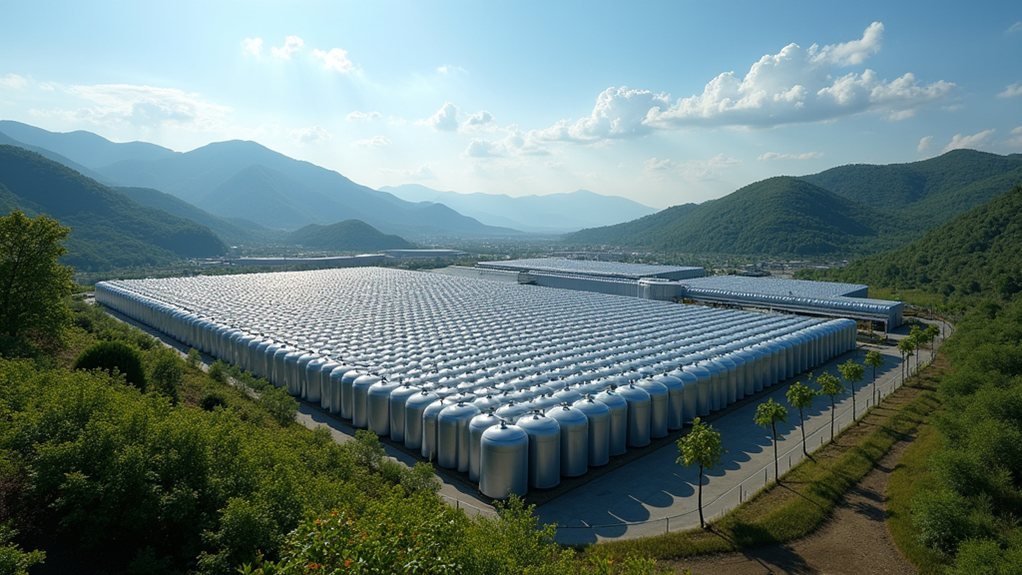
Think of it as a high-tech pantry stocked with essential ingredients—60 minerals, including rare earths like cobalt and copper, for everything from smartphones to jet engines. This initiative is crucial for countering China’s dominance in critical mineral supply chains.
With major companies involved, Project Vault promises price stability, secure access, and a strategic edge for America’s industries. Additionally, it will include all 60 minerals on the U.S. Geological Survey’s 2025 Critical Minerals List, further enhancing the nation’s resource security.
The program also seeks to support equitable transitions by considering worker and community impacts in how reserves are built and managed.
Impact of Project Vault on Global Mineral Supply Chains
While many might think of supply chains as mere arteries delivering goods from point A to point B, Project Vault turns that idea on its head by reimagining the entire landscape of global mineral supply chains.
This $12 billion initiative disrupts traditional pathways, tightening markets and fueling demand for technology metals and rare earths outside of China. As a result, the initiative could significantly tighten global supply chains and enhance competition for critical minerals. With the U.S. Export-Import Bank (Ex-Im) ready to authorize a $10 billion loan, Project Vault fosters diversification while reducing reliance on Chinese exports.
As major players like Google and Boeing join the fray, the shift promises to reshape mineral access, creating secure, robust supply chains for the future. This effort also encourages the adoption of supply chain evaluation practices to assess environmental and social performance across sourcing networks.
Essential Elements of the US and EU Critical Mineral Stockpile
The essential elements of the US and EU Critical Mineral Stockpile are not just a bunch of shiny rocks waiting to be admired; they represent a strategic lifeline in a world where supply chains can feel as fragile as a house of cards.
Funded by a historic $10 billion loan and nearly $2 billion in private capital, this $12 billion initiative targets 60 minerals vital for technology and defense. With a focus on rare earth elements and cobalt, it aims to buffer against disruptions, especially from China. This 15-year government-backed facility fosters security, price stability, and a resilient supply chain for the future. Additionally, it establishes the U.S. Strategic Critical Minerals Reserve to ensure long-term support for American industries. The initiative is guided by principles from environmental ethics that emphasize stewardship of nature alongside resource security.