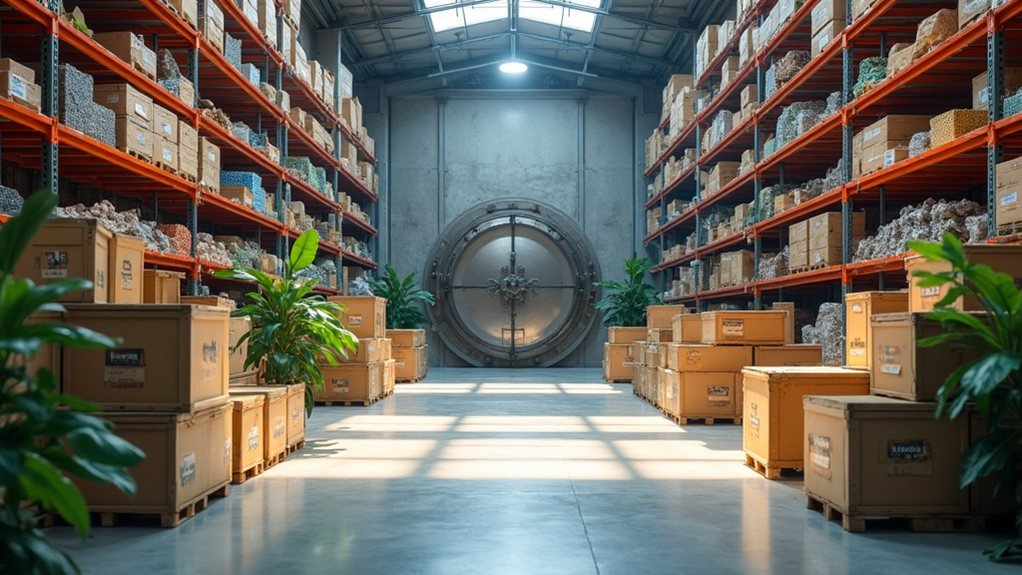

The U.S. Strategic Critical Minerals Reserve Project Vault is a game-changing initiative, boasting a hefty $12 billion stockpile aimed at securing essential resources like lithium and uranium. This reserve helps manufacturers by boosting supply chain stability and reducing reliance on foreign, especially Chinese, sources. Companies can secure their future with fixed purchase rates, while the focus on sustainable practices guarantees these minerals remain available for generations. Curious about how this impacts industries? There’s more to discover!
Quick Overview
- The U.S. Strategic Critical Minerals Reserve, announced in 2026, aims for a $12 billion stockpile of essential minerals.
- Funded by $10 billion from EXIM Bank and $2 billion in private investments, it focuses on reducing foreign reliance.
- The initiative addresses 12 critical minerals, emphasizing domestic production to enhance supply chain stability.
- Companies must commit to future purchases at fixed prices to participate in the reserve.
- Sustainable practices are prioritized, promoting environmentally conscious resource management and long-term availability of minerals.
What You Need to Know About the U.S. Strategic Critical Minerals Reserve
What exactly does the U.S. Strategic Critical Minerals Reserve entail? Announced on February 2, 2026, by President Trump, this initiative represents the country’s first stockpile of vital minerals, blending $10 billion from the EXIM Bank and $2 billion in private investments. Think of it as America’s shield against mineral shortages—an alternative to relying on foreign suppliers, especially China. This reserve will safeguard essential materials like lithium and uranium, ensuring industries can thrive without interruption. The initiative is designed as an independently governed public-private partnership to enhance the resilience of U.S. critical minerals supply chains. Additionally, it aims to catalyze private co-investment in domestic processing capabilities that are crucial for maintaining energy security. It also seeks to support sustainable supply chains by encouraging resilient, environmentally conscious domestic processing and sourcing.
Top Benefits of the $12 Billion Stockpile for Manufacturers
Manufacturers are poised to reap significant rewards from the $12 billion stockpile of critical minerals, and it’s about time they had a solid safety net. This treasure trove enhances supply chain resilience, shielding them from price shocks and geopolitical turmoil. With fixed purchase rates, companies can plan production without the nail-biting anxiety of sudden price hikes. Imagine having a reliable friend who always brings snacks—only this time, it’s minerals. By reducing dependence on China, manufacturers gain a competitive edge, ensuring access to essential materials. Ultimately, this stockpile is like a lifebuoy, keeping the manufacturing boat afloat in turbulent waters. Furthermore, the establishment of a Strategic Resilience Reserve ensures that the U.S. can counter price manipulation and support domestic production. This initiative is part of a broader effort to enhance U.S. competitiveness in the critical minerals sector. The reserve also supports long-term sustainable resource management practices to help preserve availability for future generations.
How Companies Can Engage With the Critical Minerals Reserve
While securing a spot in the Critical Minerals Reserve may sound challenging, companies can actually navigate the process with relative ease. They simply need to submit a list detailing required minerals and commit to future purchases at fixed prices. Upfront costs and storage fees must be covered, along with the loan interest tied to the minerals. Significantly, firms like Boeing and GE Vernova have already shown support. Plus, with EXIM Bank managing terms and providing substantial financing, the process becomes less intimidating. It’s like joining an exclusive club—follow the rules, and you’re in! Additionally, the Project Vault initiative represents a major effort to enhance U.S. mineral supply security. This initiative is crucial as the U.S. is 100% reliant on foreign suppliers for 12 critical minerals, highlighting the importance of domestic production. The program also emphasizes supply chain evaluation to monitor environmental and social performance across suppliers.