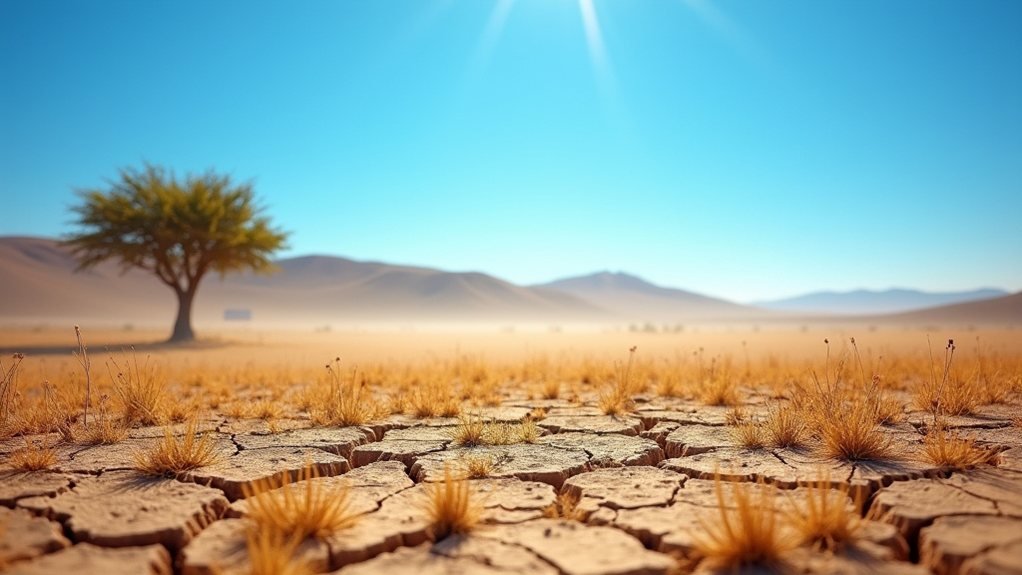

The Oxford climate study reveals a striking forecast: by 2050, around 3.79 billion people will experience extreme heat. That’s like cramming everyone in a giant sauna, except it’s not as relaxing. With a vast swath of our planet facing soaring temperatures, particularly in tropical regions, the impacts on health and productivity could be severe. Thankfully, innovative adaptation strategies, like better building designs and urban cooling, can help. Curious about what those solutions might look like?
Quick Overview
- The Oxford Climate Study predicts that 3.79 billion people will be exposed to extreme heat by 2050, significantly increasing from current levels.
- Regions most at risk include tropical Africa, India, Bangladesh, and Southeast Asia, with severe temperature spikes already observed.
- Extreme heat is expected to cost the global economy approximately $2.4 trillion annually in lost productivity by 2030.
- Urban areas, particularly those experiencing the urban heat island effect, will face heightened vulnerability to rising temperatures.
- Effective cooling strategies, infrastructure adaptation, and synchronized global policies are essential for mitigating impacts on affected populations.
Understanding Global Heat Exposure and Its Impacts
In the grand arena of climate change, extreme heat is the heavyweight champion nobody wants to face, yet humanity is stepping into the ring.
Currently, over 600 million people find themselves outside the human climate niche, with predictions suggesting this could soar to 3.79 billion by 2050. By 2030, over 2 billion people could be living outside this niche, further exacerbating the crisis. The heat doesn’t just affect comfort; it’s a productivity thief, potentially costing an estimated $2.4 trillion in lost productivity annually. With 93% of Africa’s workforce already feeling the burn, the stakes are high.
As heat stress escalates, so do health issues, turning sunny days into a serious fight for survival. Urban areas are particularly vulnerable due to the urban heat island effect, which can substantially raise local temperatures.
Buckle up, it’s going to be a scorcher.
Regions at Highest Risk of Extreme Heat
Extreme heat isn’t just a problem for the sunbathers at the beach; it’s a looming crisis with a punch that lands hardest in specific regions around the globe. Tropical Africa, particularly Nigeria and South Sudan, braces for record heat, while India and Bangladesh in South Asia face alarming temperature spikes. 23% of the global population affected by extreme heat in 2010 is expected to rise to 41% by 2050, highlighting the urgency of the situation. Additionally, nearly 3.79 billion people are projected to be at risk, underscoring the scale of this impending crisis.
Southeast Asia, with Indonesia and the Philippines, is set to experience intense heat stress, and Brazil in Latin America anticipates soaring temperatures that will push populations to their limits. Even temperate regions like Canada and the UK aren’t escaping unscathed, with hot days doubling or tripling. The heat is on! Climate responses will require both mitigation and adaptation to reduce causes and prepare for impacts.
What Can We Do to Adapt to a Hotter World?
As the planet warms, adapting to a hotter world becomes less of a choice and more of a necessity—like wearing sunscreen at the beach, you just can’t skip it anymore.
To combat extreme heat, buildings must embrace thick walls for winter and cool air conditioning for summer. Think of passive cooling strategies like natural ventilation—nature’s own air conditioner! With an estimated 3.8 billion people facing dangerous heat by mid-century, it’s critical that we start implementing these changes now. The largest population impacts are expected in India, Nigeria, Indonesia and other vulnerable regions.
Strengthening infrastructure is essential, guaranteeing healthcare and productivity don’t melt away. Policies need to align globally, like synchronized swimmers, to make certain our cooling efforts are effective.
In addition, integrating soil health practices into urban and peri-urban planning can help reduce local temperatures and support resilient food systems.
With these steps, humanity can not just survive, but thrive in a hotter world.