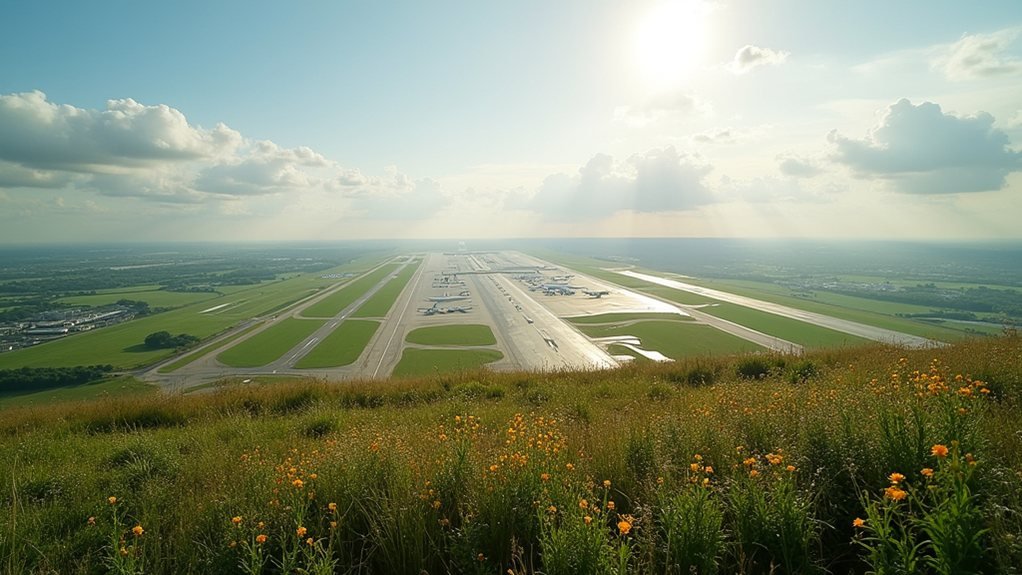

Gatwick Airport is facing a serious legal challenge from local residents and environmental groups over its plans to expand. Opponents argue that the proposed increase of 100,000 flights could boost CO2 emissions by 50%, potentially making Gatwick responsible for a whopping 5.5% of the UK’s total emissions by 2038. With concerns about noise pollution and air quality, the community is mobilizing against what they see as a reckless disregard for the environment. Stick around to uncover how this legal saga unfolds!
Quick Overview
- Gatwick Airport’s proposed expansion faces legal opposition from local groups like GACC and CAGNE over environmental assessments and climate impact concerns.
- Critics argue the expansion could increase Gatwick’s CO2 emissions by 50%, contributing significantly to the UK’s total emissions.
- Legal challenges focus on violations of EIA Regulations regarding CO2 emissions and noise pollution affecting local communities.
- A High Court hearing is scheduled for January 2026, which could delay the £2.2 billion expansion project depending on the outcome.
- The case may set important precedents for future airport expansions in the UK, emphasizing environmental justice and regulatory accountability.
Overview of the Legal Challenge Against Gatwick’s Expansion
As the legal showdown unfolds, the challenge against Gatwick Airport’s expansion emerges as a hotly debated topic, stirring emotions among local residents and environmental advocates alike.
The Gatwick Area Conservation Campaign (GACC) and Communities Against Gatwick Noise Emissions (CAGNE) have banded together, launching claims against the Department for Transport (DfT). Their arguments, led by figures like Peter Barclay and Estelle Dehon KC, challenge the expansion’s environmental assessments. With a four-day High Court hearing set for January 2026, the stakes are high. Critics argue that the plans, boasting an additional 100,000 flights, overlook significant climate impacts, igniting a fervent resistance. The CAGNE claim highlights concerns over the breach of obligations under EIA Regulations regarding CO2 emissions from inbound international flights. Furthermore, the proposed expansion is under scrutiny due to its potential to significantly increase airport’s flight capacity. A comprehensive review of impacts across a product or project lifecycle, including raw material extraction, can reveal environmental consequences often missed in narrow assessments.
Major Environmental and Noise Issues Highlighted by Opponents
Significant environmental and noise concerns are at the forefront of the opposition to Gatwick Airport’s proposed expansion, capturing the attention of both local communities and environmental advocates. Critics argue that the expansion could lead to a staggering 50% increase in CO2 emissions, pushing the airport’s contribution to 5.5% of the UK’s total by 2038. Noise pollution, already a headache for residents, would rise sharply, violating government policies meant to protect communities. Additionally, air quality could worsen, with PM2.5 particles from increased flights threatening both local health and treasured ecosystems like Ashdown Forest. The stakes are undeniably high for the environment, especially considering that Gatwick’s growth contradicts the Committee on Climate Change’s call to halt airport expansion. Increased air pollution risks include higher concentrations of fine particulate matter and other pollutants that directly affect public health, particularly through PM2.5 exposure.
Implications of Legal Challenges on Gatwick’s Future Capacity
While legal challenges may seem like a tedious affair, they hold the potential to reshape Gatwick Airport’s future capacity in significant ways.
The ongoing judicial review, spearheaded by CAGNE and local residents, questions the validity of environmental assessments and noise impacts. If successful, these challenges could stall the projected £2.2 billion expansion, transforming it from a soaring ambition to a grounded reality.
The debate isn’t just about planes taking off; it’s about climate concerns and community voices being heard. In a world where every decibel counts, these legal maneuvers could redefine what the skies over Gatwick look like for years to come.
Environmental justice also stresses that both environmental benefits and burdens should be distributed fairly, emphasizing the importance of equitable distribution when assessing project impacts.