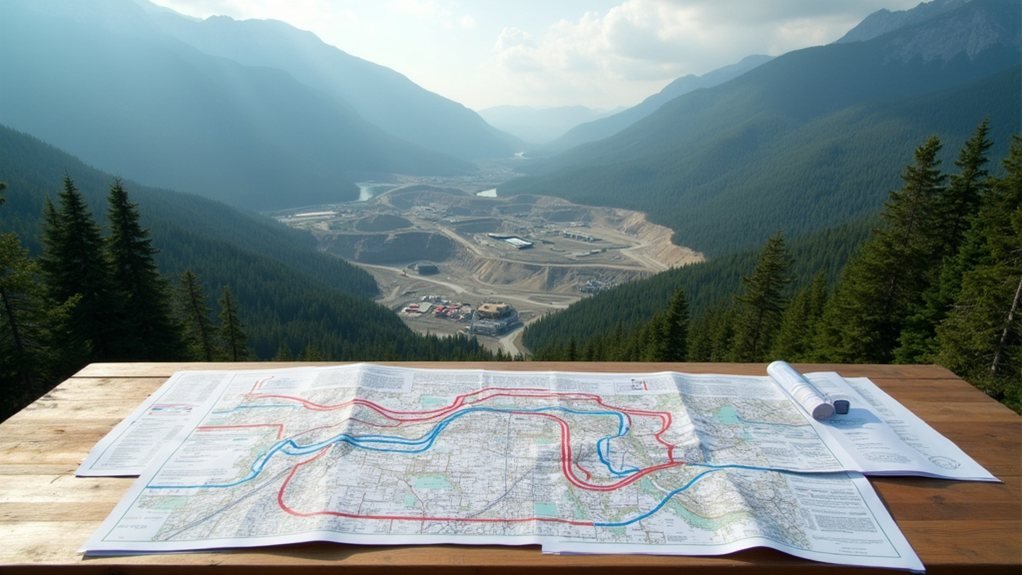

Maneuvering the world of federal and provincial mining Environmental Impact Assessments (EIAs) is like trying to walk a tightrope while juggling – confusing and chaotic. Overlapping requirements create duplicative reviews and compliance headaches, costing time and money. It’s like submitting the same homework to two teachers with different grading criteria. A lack of coordination hampers efficiency and stifles innovation. Yet, solutions like regulatory harmonization and Indigenous consultation could smooth the path ahead, opening up new possibilities. Curious about how these changes could impact mining projects?
Quick Overview
- Overlapping federal and provincial regulations create confusion and inefficiencies in mining environmental impact assessments (EIAs).
- Significant discrepancies in mine capacity reported in federal and provincial documents complicate compliance and decision-making.
- The Supreme Court’s ruling on the Impact Assessment Act in October 2023 adds uncertainty to federal mining regulations.
- Redundant submissions of similar environmental data increase costs and hinder competitiveness for mining projects.
- A ‘one project, one process’ model aims to streamline assessments and reduce duplication in regulatory frameworks.
What Are the Challenges of Overlapping Mining Assessments?
Maneuvering the maze of overlapping mining assessments in Canada can feel a bit like trying to solve a Rubik’s Cube while blindfolded—frustrating and bewildering.
With federal and provincial jurisdictions clashing, the regulatory landscape becomes a patchwork quilt of confusion. The Impact Assessment Act and Fisheries Act guide federal actions, but provincial rules vary wildly, leading to discrepancies that would make any statistician cringe. For instance, one mine’s capacity ballooned from 43,800 to 104,000 tonnes per day between documents! Additionally, the recent SCC ruling in October 2023 has deemed portions of the IAA unconstitutional, further complicating compliance for mining projects. Moreover, regulatory processes can hinder the adoption of green mining technologies and stall innovation in the sector. Effective compliance requirements must balance economic development with environmental protection to achieve sustainable mining operations.
The clash of federal and provincial regulations creates a confusing patchwork that complicates compliance in the mining sector.
As stakeholders grapple with this regulatory juggling act, the chaos only thickens, complicating compliance and ultimately stalling progress in the mining sector.
Identifying Solutions to Streamline Mining Assessments
Streamlining mining assessments is not just a bureaucratic necessity; it’s a matter of efficiency that could save time, resources, and even the environment. By embracing regulatory harmonization, provinces and territories can minimize duplication through mechanisms that substitute for federal processes. British Columbia’s data registries exemplify how transparency fosters independent oversight and informed public discourse. Furthermore, prioritizing Indigenous consultation guarantees that local voices shape mining policies. Additionally, the federal government’s jurisdiction over territories ensures that regulatory frameworks are aligned to avoid conflicts and streamline approvals. Finally, a performance-based regulatory framework can reduce uncertainties, delays, and costs, paving the way for smoother project approvals. Essentially, collaboration and clarity could transform a chaotic landscape into a well-oiled machine. Moreover, Canada’s minerals and metals industry plays a vital role in providing jobs for over 340,000 Canadians, highlighting the importance of efficient assessment processes.
How Duplication Affects Mining Assessments?
Steering through the regulatory landscape of mining assessments can feel a bit like trying to untangle a pair of headphones—frustratingly complicated and seemingly impossible at times. With overlapping federal and provincial requirements, mining projects face redundant reviews that stretch timelines like a rubber band ready to snap. Multiple submissions of nearly identical environmental data create confusion and delay, leaving project proponents in a fog of uncertainty. This duplication not only raises compliance costs but also hinders Canada’s competitiveness in the global mining arena. Ultimately, a lack of coordination turns what could be a streamlined process into a tangled mess, stalling essential development. The recent ‘one project, one process’ model introduced by the cooperation agreement aims to address these challenges and enhance efficiency. Additionally, both governments have committed to timely decision-making for regulatory processes related to critical minerals, which is crucial for accelerating project approvals.