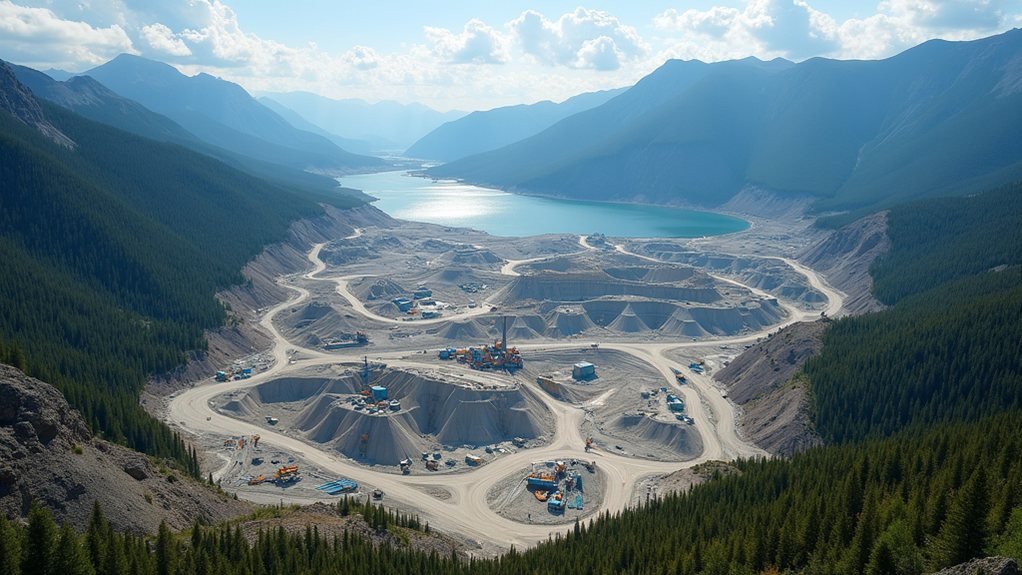

As the U.S. gears up for a new era of state-sponsored mining for critical minerals, the stakes are high. With China’s grip on these resources tightening, America aims to bolster its national security and economic resilience by 2026. Strategies like stockpiling and collaborative partnerships are vital. Think of it as fortifying a castle before the dragon arrives. Curious about how these changes will shake up the industry and investment landscape? There’s plenty more to explore!
Quick Overview
- The U.S. aims to enhance critical mineral security, reducing dependence on China by increasing domestic production and processing capabilities by 2026.
- Project Vault and the Strategic Resilience Reserve are initiatives to stockpile critical minerals and secure supply chains against geopolitical risks.
- State-sponsored mining efforts address production shortages and encourage investment while promoting environmentally responsible practices within the mineral sector.
- Collaborative efforts with allies focus on diversifying supply routes and stabilizing mineral prices to boost U.S. competitiveness globally by 2026.
- Legislative changes and executive orders are prioritizing strategic minerals, emphasizing domestic processing to strengthen national security and economic resilience.
Why We Must Address U.S. Critical Mineral Security Now
As the world speeds toward a future increasingly dependent on technology, the United States faces an urgent call to bolster its critical mineral security—a task that might feel as monumental as shoring up a sandcastle in a rising tide.
With China dominating the market, the U.S. risks its industrial and defense supply chains. Imports of refined minerals create vulnerabilities as geopolitical tensions rise. Project Vault aims to centralize a mineral stockpile for civilian use, highlighting the administration’s commitment to enhancing security in this critical area. Promoting careers in sustainability and renewable energy is a vital part of building this resilient supply chain.
In response, the U.S. Government is expanding financial support for domestic critical minerals production, underscoring the importance of establishing a robust and resilient supply chain.
Domestic processing capabilities are sorely lacking, making diversification essential. As the economy buzzes, a bipartisan push for strategic reserves emerges—a clear sign the situation demands immediate attention like a fire drill in a crowded movie theater.
Stockpiling Strategies and Partnerships for Mineral Security
While maneuvering through the complexities of critical mineral security, it becomes apparent that stockpiling strategies and partnerships are essential for the United States to fortify its supply chains. Initiatives like the $2.5 billion Strategic Resilience Reserve and Project Vault guarantee the U.S. keeps a steady supply of crucial minerals, shielding manufacturers from market chaos. Carbon markets also present opportunities to encourage environmentally responsible mining practices through carbon trading incentives. The Department of Defense’s procurement of $1 billion hints at an urgent need to fill gaps left by production shortages. Furthermore, the recent NDS expansion will enhance the U.S.’s ability to secure strategic materials crucial for defense and economic stability. In this context, the Project Vault initiative underscores the collaboration between industry leaders and the government to bolster mineral stockpiling efforts. Meanwhile, collaboration with allies fosters a united front against market volatility, which is key to thriving in the critical mineral landscape. The stakes have never been higher!
How Changes in Mineral Policy Will Affect Industry and Investment Decisions?
Finding a way through the ever-changing terrain of mineral policy in the U.S. has become a bit like trying to find the quickest route through a maze—full of twists, turns, and occasional dead ends.
New tariffs and trade deals, like price floors, are designed to fortify the market against foreign dependency. By modernizing regulations and streamlining permits, the government aims to attract investment in critical minerals. The executive order emphasizes processed critical minerals as essential for national security and economic stability. Programs like the Strategic Resilience Reserve will stabilize prices, easing investor anxieties. Ultimately, a robust policy framework could enable billions in funding, placing U.S. minerals front and center on the global stage. As the global race for critical minerals intensifies, the U.S. must proactively exploit its offshore resources to maintain competitiveness. Developing resilient and sustainable supply chains will be key to managing these shifts effectively.