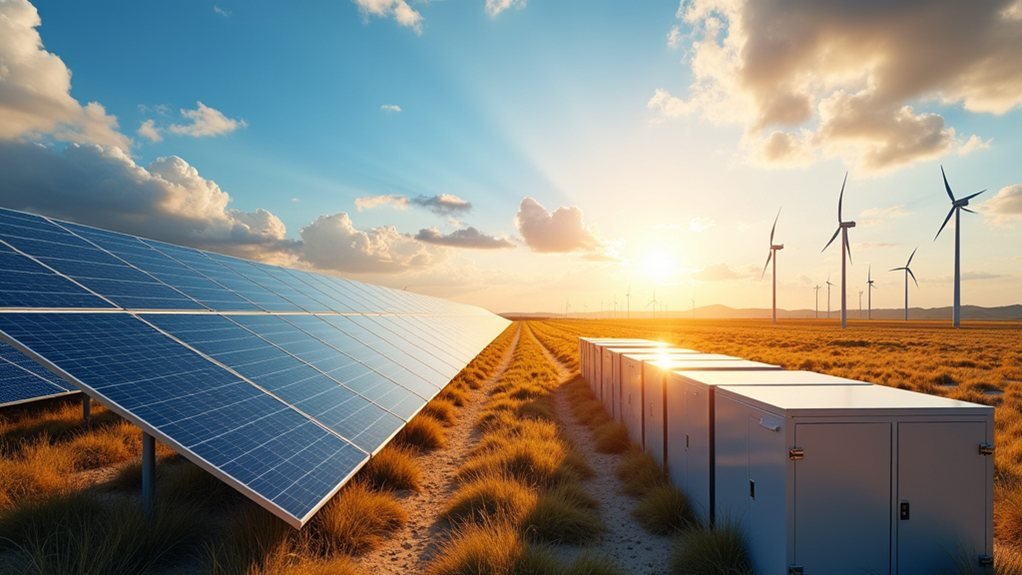

Battery storage is booming with an impressive 49% growth, spurred by the urgent need for reliable renewable energy solutions. As solar and wind power integration increases, lithium-ion batteries reign supreme, driving prices down to $115 per kilowatt-hour—less than a trip to a fancy café! Leading markets, like China and the U.S., are making major strides thanks to tax incentives and innovative technologies. However, challenges, including supply chain issues, may stall this electric progress. Stick around to find out more!
Quick Overview
- Battery storage demand is surging, driven by increased integration of renewable energy sources like solar and wind power.
- The global battery energy storage market is projected to exceed $35 billion by 2030, highlighting significant growth potential.
- Lithium-ion batteries dominate the market, with costs decreasing to $115/kWh, facilitating broader adoption.
- Emerging markets, particularly in the Middle East and Africa, are advancing in off-grid battery storage solutions.
- Innovations in battery technology, such as second-life batteries and solid-state technology, are expected to further enhance growth.
Understanding the Surge in Battery Storage Demand in 2025
As the world gears up for 2025, it’s clear that the demand for battery storage is surging faster than a kid on a sugar high after Halloween.
Multiple factors are driving this boom. The increasing integration of solar and wind power, coupled with a growing need for grid reliability, is like throwing gasoline on an already roaring fire. With lithium-ion batteries making up over 85% of the market, their plummeting costs—down to $115/kWh—are the cherry on top. Additionally, the global BESS market is projected to exceed $35 billion by 2030, signaling a robust future for the industry. Moreover, the rapid deployment of renewable energy is intensifying the demand for efficient energy storage solutions.
Add in government incentives and the rise of electric vehicles, and it’s no wonder battery storage is the hottest ticket in town. As demand increases, efficiency gains in storage technology continue to accelerate and help economies scale.
Which Global Markets Are Leading Battery Storage Growth?
While the world buzzes with excitement over the future of energy, a few key players are stepping into the spotlight as leaders in the booming battery storage market.
China reigns supreme, with CATL dominating global shipments and a rapid push for lithium battery adoption. In fact, the global market size for battery energy storage is projected to reach 114.05 billion by 2032, highlighting the explosive growth in this sector.
China leads the charge in battery storage, with CATL at the forefront of lithium battery advancements.
Meanwhile, the United States is experiencing a battery boom, spurred by tax incentives and Tesla’s high-profile projects, as the company holds a 15% market share in the global battery energy storage system (BESS) market.
Europe is catching up, bolstered by supportive policies and rising energy prices.
Emerging markets in the Middle East and Africa are also making strides, focusing on off-grid solutions.
Together, these regions are electrifying the future of energy storage, underscoring the global momentum in grid-scale storage and the push toward resilient, low-carbon power systems.
Key Challenges Facing the Battery Storage Industry and Future Outlook
Steering through the battery storage industry feels a bit like trying to assemble a complex puzzle with missing pieces; the potential is immense, but significant challenges loom large. High initial costs, limited raw materials, and safety concerns hinder rapid adoption. Imagine trying to build a LEGO castle but realizing half the blocks are missing—frustrating, right? Plus, outdated grid infrastructure is like trying to fit a square peg in a round hole. Add in market uncertainties, like China’s shifting policies, and the picture gets murkier. Yet, innovations like second-life batteries and solid-state tech hint at a brighter, more sustainable future—if only they can crack the code. As the market is projected to 150 billion by 2033, these advancements may provide the necessary momentum for overcoming existing hurdles. Notably, established domestic lithium cell manufacturers are projected to meet the anticipated demand for energy storage systems by 2026. An important factor in accelerating deployment is grid resilience improvements, which can reduce downtime and unlock higher value from storage deployments.